

What It Means for UAE Residents in 2026
Two policy shifts have rewritten the rent-vs-buy math for UAE residents in 2026. Here is exactly what changed and how to use it.
Two Big Shifts in 2026 And Most UAE Residents Haven’t Connected Them Yet
If you’re renting in Dubai right now, two things happened in 2026 that should change how you think about the year ahead.
The first is in the data. According to the Dubai Land Department’s April 2026 transaction report, the city recorded 53,693 rental contracts in a single month worth AED 4.56 billion — and 66% of them were renewals. The average annual rent across Dubai now sits at AED 85,000. Meanwhile, apartment values have climbed for 28 consecutive months, with per-square-foot prices up +17% year-on-year. Tenants are paying more, owners are getting wealthier, and the gap is widening.
The second is in the policy. On 1 May 2026, the Dubai Land Department officially confirmed that the AED 750,000 minimum property value requirement for the two-year Property Investor Visa — a rule that had stood since 2009 — has been removed for sole owners. For the first time in 17 years, modest entry-level property purchases now unlock UAE residency.
Put those two things together and the math is striking: in 2026, the same money you pay your landlord every year could be buying you a home, building equity in an appreciating asset, and securing your UAE residency status all at the same time.
Let me show you exactly how this works.
The Rental Trap: What AED 85,000 a Year Really Costs You
Run the math honestly.
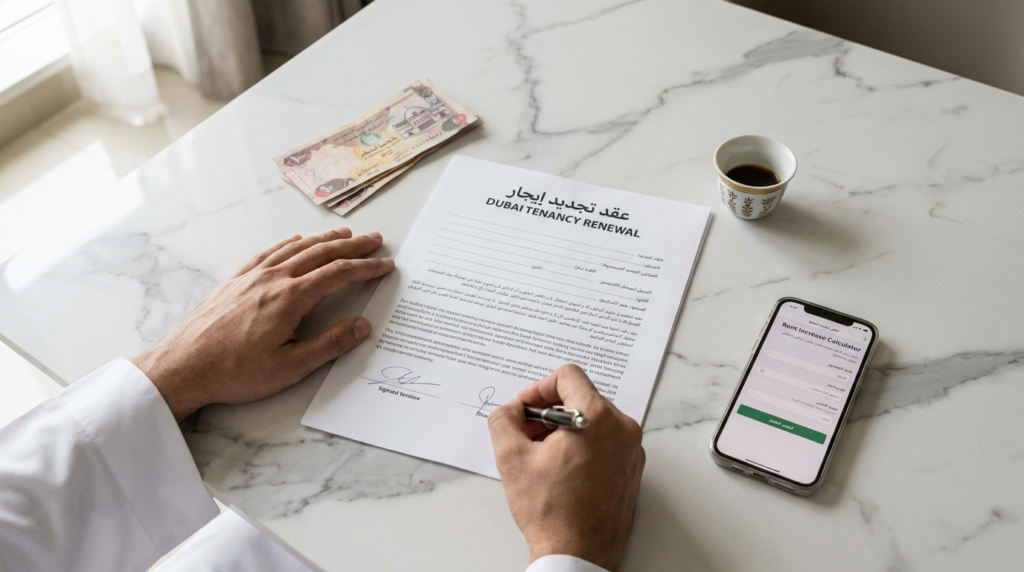
If you pay AED 85,000 in rent for ten years — assuming a modest 5% annual increase, well below what most communities are recording — you will hand your landlord approximately AED 1.07 million. Over a decade, an average Dubai tenant pays the price of a 1-bedroom apartment in Town Square or JVC, and ends up owning nothing.
Now flip the calculation. Take the same AED 85,000 a year and apply it to a mortgage on a comparable AED 1.2M apartment with a 20% down payment (AED 240,000) and a 25-year mortgage at the current Dubai market rate. Your monthly mortgage payment lands at approximately AED 5,300–5,500, or around AED 64,000 per year — meaningfully less than your annual rent.
Add typical service charges and DEWA and your true annual cost of ownership lands in the AED 80,000–90,000 range. Roughly the same as renting. Except now every payment builds equity, the property is appreciating at double-digit rates, and — under the new 2026 rules — that single purchase can also secure your residency.
This is the rent-vs-buy crossover point thousands of Dubai residents are hitting in 2026. The question isn’t whether ownership makes sense. It’s whether you’ve run the numbers on your specific situation.
The 2026 Game-Changer: The AED 750,000 Wall Has Been Demolished
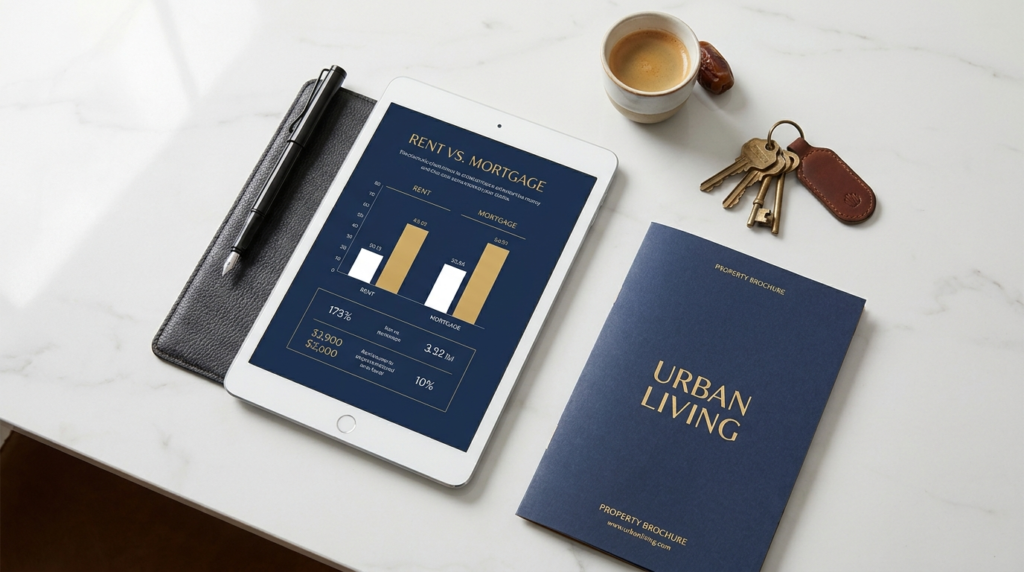
For 17 years, the gateway to Dubai’s two-year Property Investor Visa carried a single, unmoving number: AED 750,000. The minimum was set in 2009, when Dubai’s post-crisis policy was geared toward pushing higher-value transactions. In 2026, the market is fundamentally different — and the visa system has finally caught up.
Effective from late April 2026 and officially confirmed on 1 May 2026, the new framework is:
• Sole owners: No minimum property value. If you are the single registered owner of a completed Dubai property — regardless of price — you qualify to apply for the two-year residency visa.
• Joint / co-owners: Each co-owner must independently hold at least AED 400,000 in equity. So a couple buying together would need at least AED 800,000 in combined equity (AED 400K each) for both partners to qualify.
• Mortgage-backed purchases: Still eligible, but banks must issue a No Objection Certificate (NOC) confirming at least 50% of the loan has been repaid, or AED 375,000 of the property value has been paid down.
• Off-plan exclusion: The property must be completed and registered. Off-plan units under construction do not qualify for this visa pathway.
Before this update, a couple buying a AED 700,000 apartment together was excluded from the residency pathway entirely. Under the new rules, the same purchase qualifies both partners for two-year UAE residency.
What Did NOT Change: The 10-Year Golden Visa
This distinction is being misreported on social media, so internalise it clearly.
The 10-year Golden Visa via property investment still requires a minimum property value of AED 2 million. That has not changed. What did change separately, in early 2026, is that the previously required AED 1 million minimum down payment was removed for Golden Visa qualification — meaning investors can now use larger mortgage financing as long as the property is valued at AED 2M+ on a Dubai Land Department–certified basis.
So we now have three clear residency tiers driven by property:
• Two-year Investor Visa: No minimum value for sole owners; AED 400,000 per co-owner for joint ownership.
• Five-year Retirement Visa: AED 1 million in property (for applicants aged 55+).
• Ten-year Golden Visa: AED 2 million minimum property value, with no upfront down-payment floor.
The bottom barrier has been removed completely. The premium pathways stay in place. It is a clean, segmented system — and a more honest reflection of the buyer profile actually driving Dubai’s market in 2026.
The 2026 Mortgage and DLD Rules Every First-Time Buyer Must Know
Before you take any further step, internalise these UAE Central Bank and DLD rules:
• Down payment (expat residents): 20% on properties under AED 5M, 30% above.
• Down payment (UAE nationals): 15% on properties under AED 5M, 25% above.
• Maximum mortgage tenure: 25 years (subject to age limits).
• DLD registration fees (4% of property value) must now be paid in cash — they can no longer be financed into your mortgage. For an AED 1.2M apartment, that’s an additional AED 48,000 in cash you need at signing.• First-Time Home Buyer Program (launched July 2025): UAE residents purchasing their first home under AED 5M get priority access to new launches from Emaar, Damac, Sobha and Nakheel, preferential mortgage rates, and developer discounts.
Five Communities Where Your Rent Could Buy a Home And a Visa
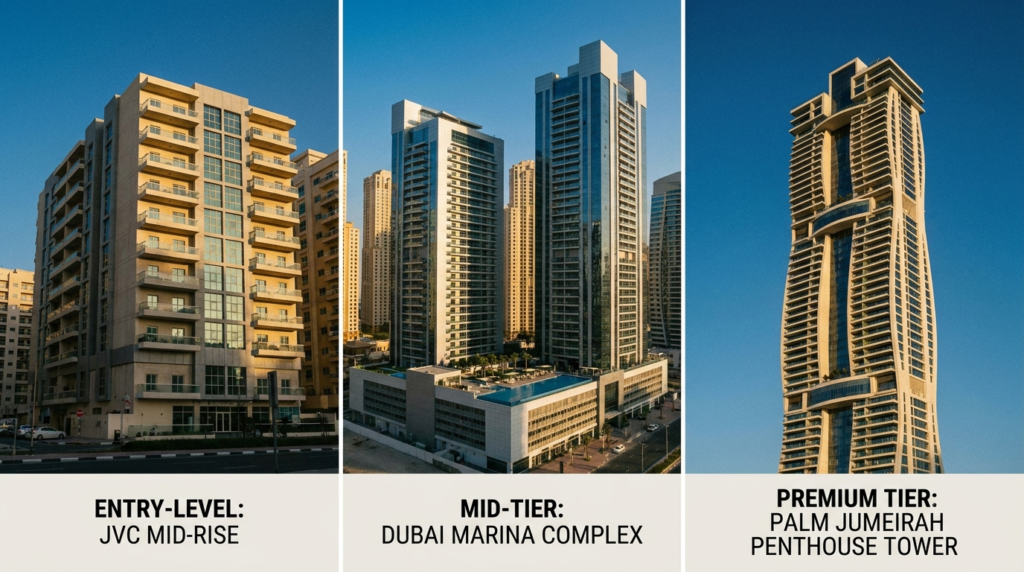
Based on April 2026 transaction data, these five communities offer the cleanest rent-to-own crossover for UAE-resident first-time buyers and several sit right at or below the levels where the new residency rules apply.
1. Jumeirah Village Circle (JVC)
860 transactions in April — Dubai’s busiest community. Studios from AED 100,000 (resale) and 1-bedrooms commonly under AED 1M. Gross yield: 8.1%. Sole-owner residency now possible at almost any price point here.
2. Town Square.
168 transactions, average price AED 1.57M, occupancy above 92.5%. Apartments from AED 450,000. Per-square-foot prices up +12.9% YoY — the strongest entry-level growth on the list.
3. Emaar South.
235 transactions, average price AED 1.71M, apartments from AED 881,000. Backed by the most trusted developer in the UAE and rapidly maturing as the next major Emaar masterplan after Dubai Hills.
4. Damac Hills 2.
Villas, yes, villas from AED 400,000. 112 transactions in April. Importantly, this hits the AED 400K-per-co-owner threshold exactly, making this an obvious choice for couples planning to apply jointly.
5. Dubai Investment Park / IMPZ.
9.2% gross rental yield. If you ever plan to upgrade and convert this first home into a rental, the income covers the mortgage almost entirely.

Three Strategic Mistakes I See First-Time Buyers Make in 2026
First, focusing on price-per-square-foot instead of total ticket and quality. A 1-bedroom in Emaar South at AED 1.46M is almost always a better long-term decision than a “cheaper” tower with no master-plan, weak service, and a developer with a thin track record. Resale liquidity matters more than per-square-foot pricing.
Second, ignoring the off-plan vs ready trade-off in light of the new visa rules. The new two-year investor visa requires a completed property. If you want residency from day one, you cannot buy off-plan. That changes the optimal strategy for many first-time buyers — pushing them toward ready inventory in JVC, Damac Hills 2, and International City rather than off-plan launches.Third, skipping the multi-year residency roadmap. Many first-time buyers buy a AED 800K apartment and stop there. Smarter buyers think three to five years ahead: start with an entry-level property under the new rules, build equity, then upgrade to AED 2M+ for Golden Visa eligibility — moving from two-year residency to ten-year residency through a structured property strategy.
The Behniya Approach: From Renter to Resident Owner
When clients come to me about these changes, my first question is rarely about price. It’s about timeline and structure.
Are you a sole buyer, or planning to co-buy with a spouse or family member? Are you building a one-property portfolio, or laying the foundation for Golden Visa eligibility in three to five years? Do you have the cash to clear a 50% mortgage milestone, or do you want a property where ownership equity is straightforward from day one?
The right entry property changes dramatically depending on these answers. A AED 500,000 unit in International City might be the smartest choice for a remote worker who wants residency now and will trade up later. A AED 1.2M apartment in JVC might fit better for a couple co-buying under the AED 400K-each rule and looking for stronger appreciation. A AED 1.8M apartment in Emaar South might be ideal for someone only AED 200K away from Golden Visa eligibility and could be nudged across the line with a small additional investment.
This is where strategy beats sticker price. The combination of falling residency barriers and a deep, transparent rental market means 2026 is the year first-time buyers can convert their rent into something far more valuable than just shelter.
No pressure. No commission-driven recommendations. Just transparent, data-driven advice grounded in the same Dubai Land Department transaction data the largest funds use to make their decisions.

Your Next Step → Book a Free Consultation
If you’re renewing a lease in 2026, do yourself one favour before you sign: spend 30 minutes finding out whether ownership is actually within reach and whether the new visa rules apply to your situation. The answer surprises most of my clients.
In a free 30-minute consultation we will cover:
• Your personalised rent-vs-buy break-even analysis
• Whether the new two-year investor visa pathway fits your situation
• A shortlist of 3–5 communities matching your budget, lifestyle, and visa goals
• A multi-year residency roadmap from two-year visa to Golden Visa eligibility
• The mortgage and NOC strategy if you plan to use bank financing
→ Book your free 1-on-1 consultation
→ Connect with me on LinkedIn for weekly market and policy briefs
— Behniya