The Timing, Tax, and Financing Playbook
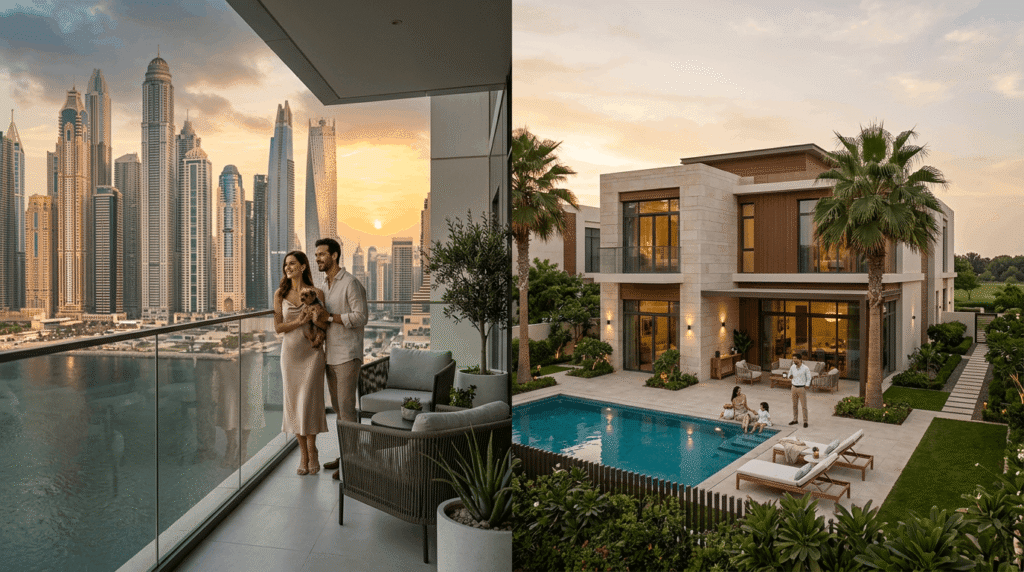
You bought your first apartment in Dubai. Maybe it was a one-bed in JVC, a two-bed in Marina, or a studio in Business Bay. It made sense at the time. But now you’ve got a growing family, a dog, a work-from-home setup that doesn’t fit in a second bedroom, and a child who needs a school within driving distance that doesn’t involve Sheikh Zayed Road at 7:45am.
You’re ready for a villa. And you’re not alone. Villa and townhouse prices in some Dubai communities have surged over 200% in the last three years, driven by family demand, limited supply, and a permanent post-pandemic shift toward space and privacy. Meanwhile, the apartment market is entering a stabilisation phase as new supply floods in — over 55,000 units are expected to be delivered in 2026 alone, with 86% of the pipeline being apartments.
This creates a specific window: if you’re sitting on apartment equity, the gap between apartment values (plateauing) and villa values (still climbing) is widening. Every month you wait, the upgrade costs more.
This guide covers the exact mechanics of making the switch: when to sell, what it costs, how to handle your mortgage, and which communities actually make sense for families right now.
Why 2026 Is a Strategic Window for the Apartment to Villa Upgrade
The data tells a clear story about where the Dubai market sits right now, and why the timing specifically favours upgraders.
Villas are structurally undersupplied
Apartments make up approximately 86% of Dubai’s development pipeline, while villas and townhouses account for only around 14%. The existing market composition is roughly 80% apartments and 20% villas. This means the supply gap in the villa segment is getting wider, not narrower. Knight Frank’s research confirms that villa prices and rents continue to outperform apartments due to limited availability and sustained demand from families and high-net-worth residents relocating to Dubai.
Villa prices have massively outperformed apartments
According to Allsopp & Allsopp data, average villa and townhouse prices in communities like Al Waha rose 265% between 2022 and 2025 (from AED 1.2M to AED 4.4M), while Nad Al Sheba saw 207% growth (AED 3.07M to AED 9.44M). Dubai South and Dubai Investment Park both recorded 185% increases. Meanwhile, apartment price growth has moderated significantly, with market analysts describing the apartment segment as entering a “stabilisation phase.”
Apartments are absorbing new supply; villas aren’t
Studios and one-bedroom apartments are experiencing slower absorption rates as new inventory hits the market, while larger family homes continue to attract buyers. Approximately 55,000 residential units are expected to be handed over in 2026, with around 75,000 in 2027 — the vast majority being apartments. For villa owners, this means continued price strength. For apartment owners considering an upgrade, it means your asset may be near its peak value relative to the cycle.
Population growth is family driven
Dubai added over 208,000 new residents in the past year alone, a 5.2% increase. Critically, much of this growth is family-driven — expatriate families choosing Dubai as a long-term base rather than a temporary posting. This has pushed demand for larger homes near schools, parks, and community infrastructure well above pre-pandemic levels. The Dubai 2040 Urban Master Plan targets 5.8 million residents, and suburban villa communities are central to that growth.
The bottom line: if you own an apartment and want a villa, your apartment equity is likely near its cyclical peak while villa prices continue to appreciate. The cost of waiting is quantifiable.
The Financial Mechanics: What It Actually Costs to Upgrade
This is where most upgraders get surprised. The cost isn’t just the price difference between your apartment and the villa. There are transaction costs on both sides — selling and buying — that add up significantly.
Costs When You Sell Your Apartment
| Selling Cost | Rate/Amount | On AED 1.5M Sale |
| Agent Commission | 2% + 5% VAT | AED 31,500 |
| Developer NOC Fee | AED 500–5,000 | ~AED 1,000 |
| Mortgage Early Settlement (if applicable) | 1% of outstanding or AED 10,000 max | Up to AED 10,000 |
| Mortgage Release Fee (DLD) | AED 1,290 | AED 1,290 |
| Trustee Fee | AED 4,000 + 5% VAT | AED 4,200 |
| Title Deed Fee | AED 580 | AED 580 |
Estimated total selling costs on a AED 1.5 million apartment: approximately AED 48,000–50,000 (around 3.3% of the sale price).
Costs When You Buy the Villa
| Buying Cost | Rate/Amount | On AED 4M Villa |
| DLD Transfer Fee | 4% of purchase price | AED 160,000 |
| Trustee / Registration Fee | AED 4,000 + 5% VAT | AED 4,200 |
| Title Deed Issuance | AED 580 | AED 580 |
| Agent Commission (if applicable) | 2% + 5% VAT | AED 84,000 |
| Mortgage Registration Fee | 0.25% of loan + AED 290 | ~AED 7,790 |
| Bank Valuation Fee | AED 2,500–3,500 | ~AED 3,000 |
| Bank Arrangement Fee | 0.5–1% of loan | ~AED 15,000 |
| DEWA / Move-in Deposits | AED 2,000–4,000 | ~AED 4,000 |
Estimated total buying costs on a AED 4 million villa: approximately AED 275,000–280,000 (around 7% of the purchase price).
Combined Upgrade Cost: The Number Nobody Tells You
Selling a AED 1.5M apartment + buying a AED 4M villa = approximately AED 325,000–330,000 in total transaction costs on top of the price difference. This is the number you need to build into your financial plan from day one. It’s not optional, and most of it is non-negotiable (the 4% DLD fee alone on the villa is AED 160,000).
Strategic tip: In some market conditions, you can negotiate a 50/50 split of the DLD fee with the villa seller. This alone saves you AED 80,000 on a AED 4M purchase. Always negotiate this in the MOU before signing.
Handling Your Mortgage: The Three Options
If you have an existing mortgage on your apartment, managing it is one of the most important parts of the upgrade process. There are three approaches:
Option 1: Sell First, Then Buy (Sequential)
How it works: Settle your existing mortgage from the apartment sale proceeds, pocket the equity, then apply for a fresh mortgage on the villa.
Pros: Cleanest approach. No overlapping mortgage payments. You know your exact budget before villa shopping. Fresh mortgage means you can shop for the best rate across banks.
Cons: You need interim housing (rental) between selling and buying. In a rising villa market, delays cost you money. Bank early settlement fee applies (capped at 1% of outstanding balance or AED 10,000, whichever is lower).
Best for: Buyers who aren’t in a rush and want complete financial clarity before committing to the villa purchase.
Option 2: Buy First, Then Sell (Bridge)
How it works: Secure the villa purchase (with a new mortgage) while still holding the apartment. Sell the apartment after moving in.
Pros: No interim rental needed. You can move directly. You lock in the villa price in a rising market.
Cons: You carry two mortgages simultaneously. Banks will stress-test your income against both obligations. You need strong cash reserves for the villa down payment (minimum 20–25% for UAE residents, meaning AED 800,000–1,000,000 on a AED 4M villa). Your DBR (Debt Burden Ratio) must remain below 50% of income.
Best for: High-income households with strong liquidity who can carry dual payments for 3–6 months.
Option 3: Buyer Settles Your Mortgage (Coordinated Transfer)
How it works: The apartment buyer’s bank settles your outstanding mortgage directly. Both banks coordinate on transfer day at the trustee office. The sale and purchase can be sequenced to happen within weeks of each other.
Pros: Avoids early settlement penalties in some cases. No gap between transactions if timed well.
Cons: Requires tight coordination between four parties (you, buyer, your bank, buyer’s bank). The process typically takes 2–6 weeks for the mortgage release. You need all documentation prepared in advance: liability letter from your bank, buyer’s pre-approval, developer NOC, and trustee booking.
Best for: Most upgraders, provided they plan 6–8 weeks of coordination time and have a competent conveyancer managing the process.
Critical detail: Request your bank’s liability letter EARLY. This document shows the exact outstanding amount and is valid for a limited period. If it expires before transfer, you need a new one, which can delay everything.
When to Sell Your Apartment: Timing the Market in 2026
There’s no perfect moment, but there are objectively better and worse periods based on current market dynamics:
Q1–Q2 2026 (January–June): Strongest selling window
Dubai’s real estate market traditionally sees its highest transaction volumes between October and April. January 2026 set records with AED 111 billion in transactions. Buyer demand peaks when the weather is pleasant and before summer. If your apartment is priced competitively against recent comparables, this is when you’ll attract the most buyers.
Summer 2026 (July–September): Weaker period
Vacancy rates are expected to rise during summer months, and rental demand softens as business activity slows and temperatures peak. If you’re relying on your apartment generating rental income while on market, summer may see lower offers. However, villa purchases may also be less competitive during this period, which could work in your favour on the buying side.
Q4 2026 (October–December): Second peak
The market picks up again as residents return and Expo City / major events drive activity. This is historically a strong period for both selling and buying, but competition increases on both sides.
Practical advice: List your apartment 2–3 months before you want to seriously start villa shopping. This gives you time to test the market, adjust pricing if needed, and enter villa negotiations from a position of certainty about your sale proceeds.
Best Villa Communities for Upgrading Families in 2026
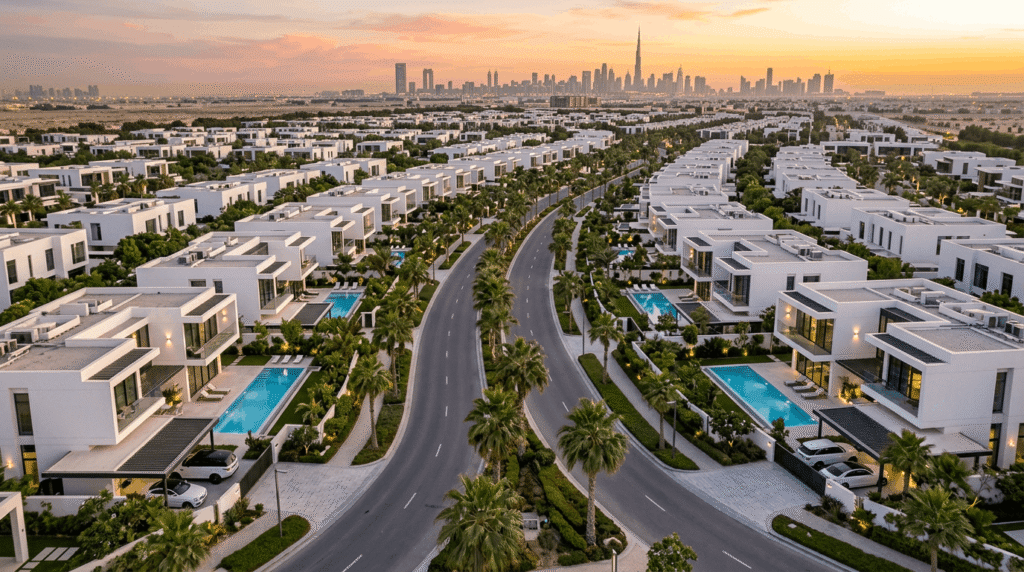
Not every villa community is right for a family upgrading from an apartment. You need a balance of price point (realistic with apartment equity + mortgage), school proximity, community maturity, and resale strength. Here are the communities that best fit this profile:
| Community | Villa/TH Price Range | Bedrooms | Key Schools Nearby | Yield |
| Dubai Hills Estate | AED 5M–15M+ | 3–6 BR | GEMS Wellington, DHE schools | ~4.8–6% |
| Arabian Ranches 1/2/3 | AED 2.6M–15M | 3–6 BR | Ranches Primary, Jebel Ali School | ~4% |
| Tilal Al Ghaf | AED 3.8M–52M+ | 3–7 BR | RGS Guildford Dubai | ~5.2% |
| Al Furjan | AED 3.5M–8M | 3–5 BR | Arcadia School, GEMS | ~5–6% |
| Town Square (Nshama) | AED 1.5M–3M | 3–4 BR | Greenfield Int’l School | ~5.5–6% |
| DAMAC Hills | AED 2.5M–10M | 3–6 BR | GEMS Metropole | ~5% |
| The Valley (Emaar) | AED 1.6M–4M | 3–5 BR | Planned new schools | TBD (new) |
Dubai Hills Estate
The anchor choice for upgrading families. It combines a master-planned community with proximity to schools, Dubai Hills Mall, and extensive green space including a golf course. Townhouses start around AED 5M, with villas running higher. Off-plan villa prices have risen approximately 59% in the last three years. Strong resale liquidity and long-term investment fundamentals. The community is considered one of the safest long-term residential investments heading into 2026.
Arabian Ranches (1, 2, and 3)
The original Dubai villa community and still one of the most established. Arabian Ranches offers a proven, family-focused environment with schools, equestrian facilities, community centres, and mature landscaping. Average villa prices sit around AED 8 million for Phase 1 and 2, with Arabian Ranches 3 offering more accessible entry points from AED 2.6M for newer townhouses. Handovers for Phase 3 are scheduled from 2026 onwards with schools, retail, and Central Park planned.
Tilal Al Ghaf
The premium newcomer, developed by Majid Al Futtaim. Anchored by a 70,000-square-metre crystal lagoon with sandy beaches, 11km of cycling tracks, and 18km of walking trails. Entry-level townhouses in the Elan sub-community start around AED 3.8–5M, with standalone villas in Harmony from AED 6M. Property values have risen approximately 18% year-on-year. The Royal Grammar School Guildford Dubai is located within the community. Full completion expected by 2027.
Al Furjan
Often overlooked but strong for upgraders. Metro access (Route 2020 extension), quieter streets, and established infrastructure at a lower price point than Dubai Hills or Arabian Ranches. Villas from around AED 3.5M. Good proximity to schools and retail pavilions. Ideal for families who want suburban living without the premium pricing.
Town Square by Nshama
The most budget-friendly villa option for families. Townhouses from approximately AED 1.5M make this accessible for upgraders selling a one-bedroom apartment. Mediterranean-inspired designs, rooftop terraces, community events, and an increasingly vibrant retail scene. Best suited for younger families or those prioritising value over prestige.
The Valley by Emaar
Emaar’s mid-market villa play along Al Ain Road. Starting prices around AED 1.6M position it as one of the most affordable Emaar villa communities. Still in development with planned schools, retail, healthcare, and new road links to Dubai Creek Harbour. A long-term play with strong appreciation potential but less immediate infrastructure than established communities.
Service Charges: The Cost Most Upgraders Forget
When you move from an apartment to a villa, your service charge profile changes significantly — and often in your favour.
Apartment service charges in mid-market buildings range from AED 13–28 per square foot (e.g., JLT averages AED 13–17/sqft, Dubai Marina AED 14–28/sqft). A 1,000 sqft apartment might cost AED 15,000–25,000 per year in service charges.
Villa service charges are typically much lower per square foot — AED 2–6 per square foot in most communities. A 3,000 sqft villa might cost AED 8,000–18,000 per year, despite being three times the size. Recent adjustments in 2026 have also seen 10–15% reductions in service charges across several mid-market communities.
However, villa owners are responsible for their own garden maintenance, pool upkeep (if applicable), and external repairs that would otherwise be covered by building management in an apartment. Budget an additional AED 10,000–20,000 per year for these costs depending on the property size and whether you have a pool.
Net result: Your total annual ownership cost for a villa is often similar to or only slightly higher than a well-maintained apartment, despite having 2–3x the living space. This is one of the strongest financial arguments for upgrading.
Golden Visa Implications When Upgrading
If your current apartment is the basis of your Golden Visa, selling it will cancel the visa unless you take specific steps:
- If your new villa is worth AED 2 million or more, you can transfer your Golden Visa eligibility to the new property. Ensure the new Title Deed is registered before the old one is released.
- If you’re upgrading from a Taskeen (2-year property visa) to Golden Visa territory, a villa purchase at AED 2M+ automatically qualifies you for the 10-year Golden Visa — a significant residency upgrade alongside the lifestyle upgrade.
- Timing is critical: don’t let there be a gap between selling the old property and registering the new one. Work with your conveyancer to ensure the Title Deed on the villa is issued before the apartment sale is finalised at DLD, or within the same visit to the trustee office.
Under the 2026 Golden Visa rules, mortgaged properties and even off-plan villas now qualify for the visa, provided you obtain a bank NOC and the total value meets AED 2 million. This means upgrading to a villa doesn’t just improve your lifestyle — it can also secure or upgrade your long-term residency status.
The Upgrade Checklist: Your Step-by-Step Timeline
3–4 Months Before Listing Your Apartment
- Get your apartment valued by 2–3 agents. Compare recent comparable sales in your building, not just asking prices.
- Request your mortgage liability letter from your bank. Know your exact outstanding balance.
- Calculate your expected net proceeds after all selling costs (agent commission, NOC, settlement fees, trustee).
- Get mortgage pre-approval for the villa purchase. Know your maximum budget before you start looking.
- Research target villa communities. Visit on weekdays and weekends. Check school enrolment availability.
When You List Your Apartment
- Price competitively from day one. In a market with increasing apartment supply, overpricing costs you time and money.
- Prepare a “transfer-ready pack”: title deed, NOC application submitted, mortgage clearance process initiated.
- Begin serious villa viewings in parallel. Shortlist 3–5 properties.
When You Have a Buyer for Your Apartment
- Sign the MOU. Negotiate DLD fee allocation on the villa side simultaneously.
- Coordinate with your bank for mortgage release. Request the liability letter immediately if not already done.
- Sign MOU on the villa (if Option 3 timing). Book trustee appointment for both transactions if possible.
- Confirm school enrollment for children before committing to the villa location.
- Arrange interim accommodation if needed (typically 2–4 weeks between transactions).
Transfer Day and After
- Complete apartment sale at trustee office. Receive proceeds.
- Complete villa purchase at trustee office. Pay DLD fees (manager’s cheque for the 4%).
- Set up DEWA account for the villa. Transfer or cancel Ejari on old apartment.
- If Golden Visa applies, initiate the transfer to the new property immediately.
- Update address with banks, schools, employers, Emirates ID.
Frequently Asked Questions
You pay DLD-related fees on both transactions, but they’re structured differently. On the sell side, the buyer typically pays the 4% DLD transfer fee (though this is negotiable). Your main selling costs are agent commission, NOC, mortgage settlement, and trustee fees. On the buy side, you’ll pay the full 4% DLD transfer fee on the villa purchase. So yes, there are DLD-related costs on both sides, but you’re not paying 4% twice personally unless you’re also splitting the fee on the sell side.
This depends on when and where you bought. If you’re underwater (owe more than the property is worth), the upgrade becomes much harder financially. In this case, consider holding the apartment as an investment/rental and buying the villa as a separate purchase, provided your income supports the additional mortgage. Rental yields on apartments in areas like JVC can reach 7–7.5%, which may cover or exceed your mortgage payments.
The 4% rate itself is non-negotiable — it’s a government fee. However, who pays it is entirely negotiable between buyer and seller. In practice, buyers typically pay the full 4%, but in a balanced or buyer-friendly market, many sellers agree to a 50/50 split. Some developers also waive or cover DLD fees on off-plan purchases during promotional periods (Ramadan, Dubai Shopping Festival, year-end).
The Bottom Line
Upgrading from an apartment to a villa in Dubai isn’t just a lifestyle decision — it’s a financial one with significant implications in both directions. The structural dynamics of the 2026 market, where apartment supply is expanding while villa supply remains constrained, create a specific window for families who are ready to make the move.
The key is preparation. Know your numbers before you list. Understand the full cost on both sides. Get your mortgage situation clarified early. Choose a community based on schools and daily life, not just price per square foot. And coordinate the timing to minimise the gap between selling and buying.
If you do the math properly, many families find that the monthly cost difference between owning a villa and owning an apartment is smaller than expected — especially when you factor in lower per-square-foot service charges, the absence of capital gains tax, and the lifestyle return on investment that comes with giving your family space, a garden, and a community designed for the way they actually live.