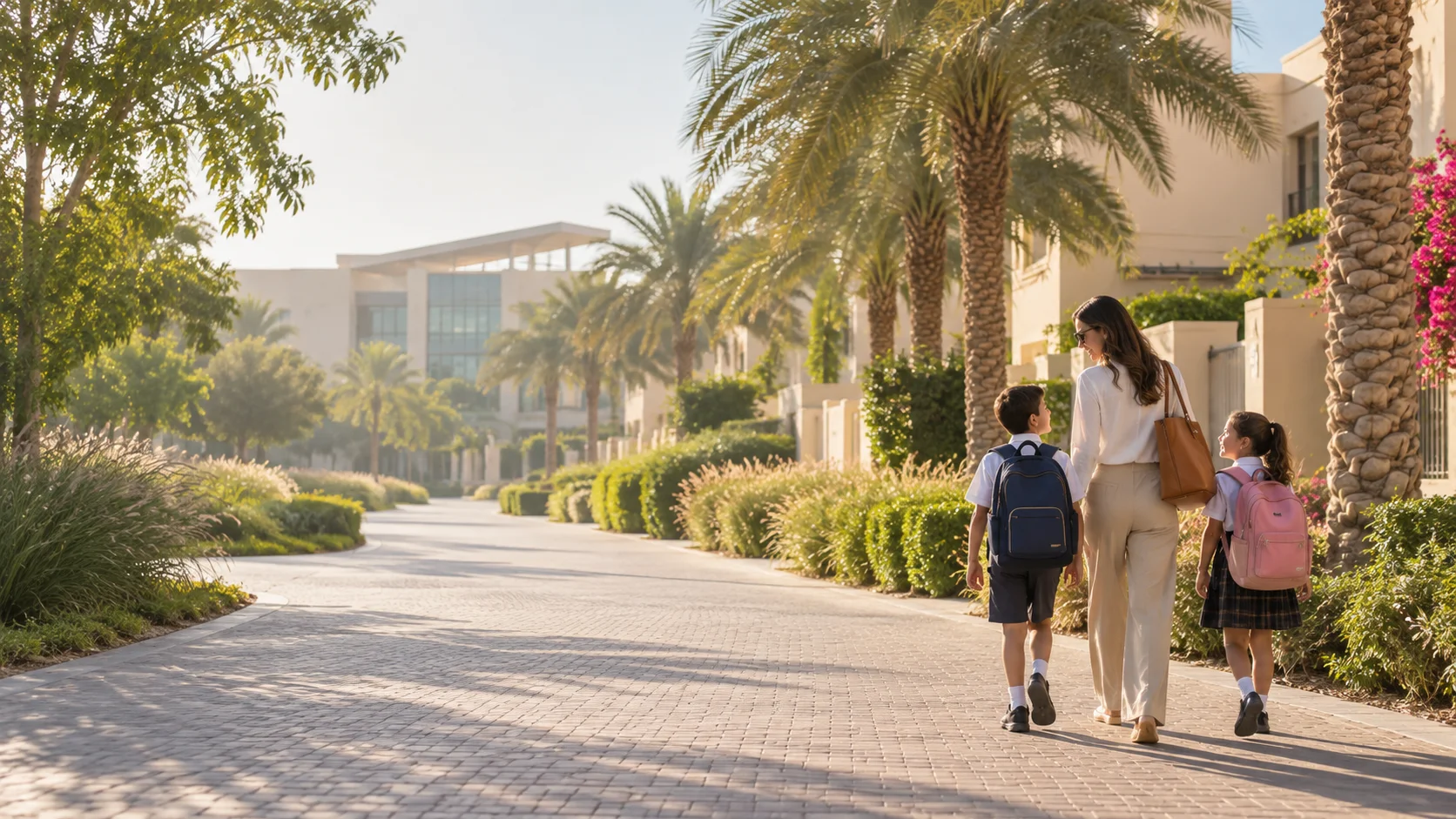
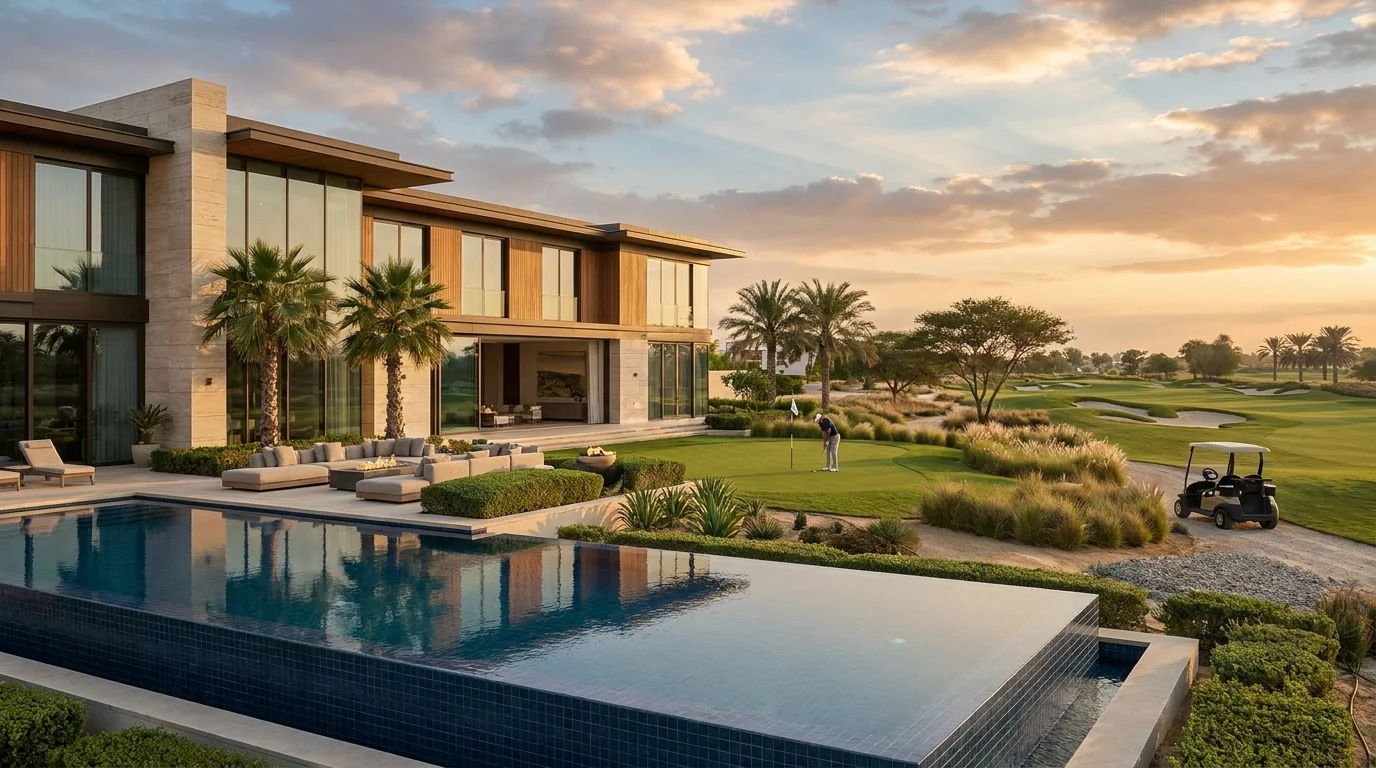
A Dubai community that has delivered roughly 1,800 homes since 2009 has just announced plans for 12,345 more. Here is what that actually means for anyone thinking about buying.
That opening comparison is the reason Jumeirah Golf Estates The Next Chapter deserves scrutiny rather than a skim. This is not a typical adjacent-plot extension. Launched in May 2025, the second phase spans 4.68 million square metres ( larger than the 375-hectare community it attaches to ) and is planned to house 51,700 residents. If it completes as drawn, the Jumeirah Golf Estates that exists today becomes roughly one-eighth of the Jumeirah Golf Estates that will exist tomorrow.
For investors, that creates an unusual situation. You are buying into an address with fourteen years of recorded resale transactions and two established championship golf courses, genuine price history, not a rendering, while simultaneously buying into a masterplan whose eventual scale and composition are still years from being visible on the ground.
Those two facts pull in different directions. Understanding the tension between them is the whole investment question.

What Is Jumeirah Golf Estates?
Jumeirah Golf Estates is an established golf-anchored residential community in Dubai’s Me’aisem area that has been handing over homes since 2009. Its track record is the foundation of everything The Next Chapter is selling.
The golf infrastructure is a commercial asset, not decoration
Two championship courses ( Earth and Fire, both Greg Norman designs ) opened in 2009. The community has hosted the DP World Tour Championship every year since, with a stated purse of US$10 million. Per the brochure, the event is contracted at Jumeirah Golf Estates through 2031.
This matters beyond branding. A contracted professional tournament delivers recurring international exposure to precisely the demographic that buys AED 13M+ villas, without the developer paying for that exposure directly. It also creates a maintenance floor: a course hosting a tour event must be kept to tour standards, which protects the quality of the asset your villa overlooks.
Worth noting
The tournament contract runs to 2031. What follows is not disclosed. An investor with a ten-year hold is buying past the edge of that commitment.
Supporting facilities include the Tommy Fleetwood Academy at the DP World Golf Performance Centre, a Tennis Academy by Tennis 360, and clubhouse amenities spanning an Olympic-sized pool, resort pool, children’s pool, tennis and padel.
What Is Jumeirah Golf Estates, The Next Chapter?
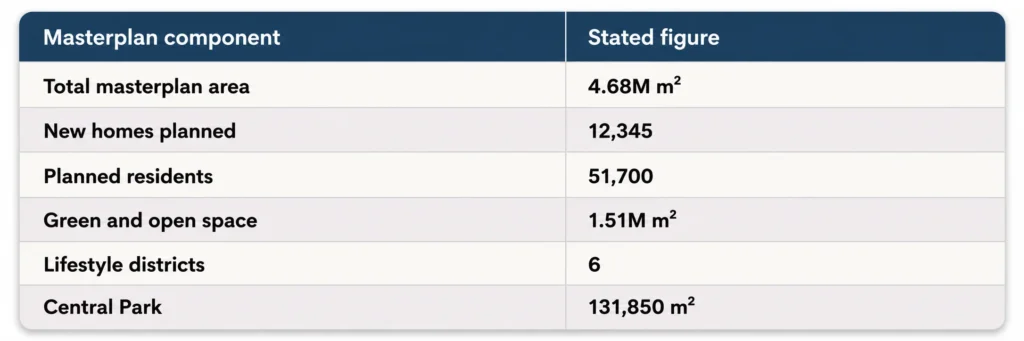
The Next Chapter is the second phase: a 4.68 million m² masterplan launched in May 2025, immediately adjacent to the original community.
The developer’s framing is that Phase 2 shares “the same gates, the same golf address and the same operator” as Phase 1. The strategic logic is sound, the new land inherits an established brand and an operating amenity base on day one, rather than spending a decade building credibility from zero.
Two ratios worth extracting
Green space is roughly 32% of the masterplan area. In a villa community, landscape allocation is not decoration, it is the primary defence of the low-density character that justifies the price premium. A plan committing a third of its land to open space has structurally limited how densely it can build later.
The plan implies about 4.2 residents per home (51,700 ÷ 12,345). That is a family-weighted assumption, not a studio-and-one-bed assumption. It tells you the developer is planning around household formation rather than transient rental demand.
Common misreading
The 12,345 homes are not all villas. The masterplan explicitly includes high-rise apartments within its transit-oriented district. Any analysis treating the entire second phase as low-density villa product is misreading the plan, and this distinction materially affects how the community will eventually feel and price.
What Will Be Built? The Masterplan Explained
The second phase is organised into six lifestyle districts anchored by a defined set of components.
Golf and sport
- A third 18-hole championship golf course, bordered by villas, with Hilltop Mansions at the district’s centre
- A 5,000-seat tennis stadium, described as the masterplan’s centrepiece
- An equestrian centre with a horse trail through wooded areas
Hospitality
- A Mandarin Oriental five-star hotel and golf resort
- Branded residences adjacent to the hotel
Retail, education, health and community
- A Town Centre mall, plus 48,000 m² of retail and dining
- An international school in the Village District
- An onsite health facility
- Three mosques
Reading the amenity list economically
Amenity lists are easy to skim. The investment-relevant question is not what is being built but which demand each component unlocks.
The school, health facility and mosques are end-user infrastructure. They convert a location from somewhere people buy into somewhere people live, and family occupancy is the stickiest tenancy type in Dubai. Families relocate around school placement, sign longer leases, and churn far less than single professionals in apartment stock. For a landlord that means lower vacancy friction, though the brochure supplies no rental data to quantify it.
The Mandarin Oriental, tennis stadium and equestrian centre do something different: premium positioning. A five-star operator conducts its own due diligence before attaching its name to a location, and its presence anchors a price tier for surrounding stock. The equestrian and stadium components add uses most Dubai communities cannot replicate without comparable land, and land of this scale, this close to established infrastructure, is not readily reproducible.
The 48,000 m² of retail matters for a subtler reason: community maturity timing. Master communities typically endure a lag between handover and daily-life viability, during which residents drive elsewhere for groceries and dining. Committed retail at scale shortens that lag, but only when it opens, which is a date the brochure does not give.
Location and Connectivity
Road access
Jumeirah Golf Estates sits against four highway corridors, with four community entry points:
- E311 — Sheikh Mohammed Bin Zayed Road
- D57 — Al Yalayis Street
- D59 — Al Jamayel Street
- E44 — Al Khail Road
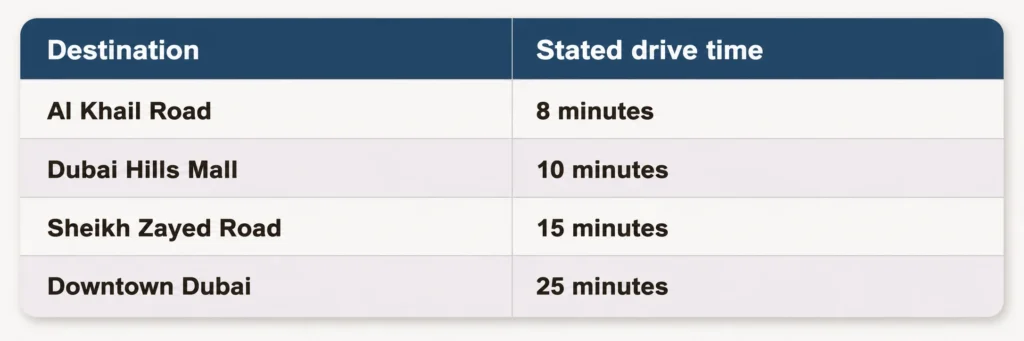
The brochure also maps the community’s position relative to Dubai Marina, Palm Jumeirah, Downtown Dubai, Dubai International Airport and Al Maktoum International Airport, but gives no stated travel time for those, so we do not assign one.
Do this yourself
Verify drive times at peak hours before treating them as a purchase input. Marketing drive times are rarely measured at 8am on a Tuesday.
The meaningful point about the four-corridor position is redundancy rather than raw speed. A community served by a single arterial road inherits that road’s congestion profile permanently. Multiple independent corridors mean one bottleneck does not define the commute for every resident.
The rail thesis: three assets, one address
Connectivity is where The Next Chapter makes its most distinctive claim.
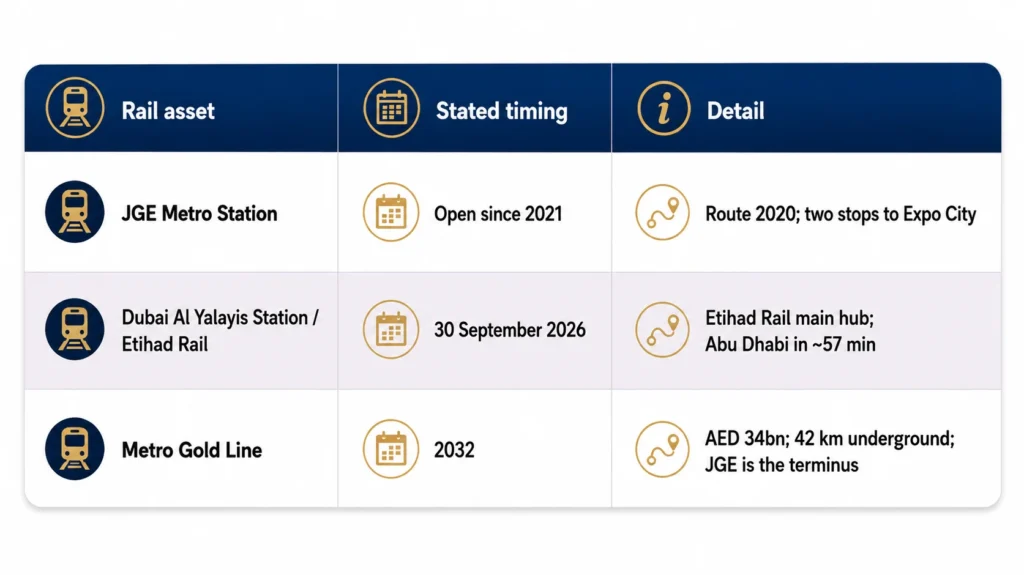
The masterplan places the Etihad Rail hub at the centre of a dedicated Transit-Oriented Development District, described as including high-rise apartments, a shopping complex, and a footbridge to the adjacent metro station.
Why this matters and where to be careful
Infrastructure-driven appreciation is one of the more historically reliable mechanisms in Dubai real estate, because transport nodes change a location’s accessible catchment rather than merely its amenity. A national rail terminus placing Abu Dhabi within a stated ~57 minutes reframes the address for a specific buyer: the cross-emirate professional who wants villa living without an unmanageable commute. Being a terminus rather than an intermediate stop is structurally significant too, termini concentrate footfall and commercial activity rather than passing it through.
Three cautions belong alongside that:
Timing. Cedarwood Estates South hands over Q1 2029. The Gold Line is dated 2032. An investor buying today takes possession several years before the full transport case materialises, and infrastructure timelines slip. Build a thesis that survives delay.
These are brochure-stated dates. The 30 September 2026 Etihad Rail date and the 2032 Gold Line date are developer claims reproduced as such. Confirm current status with primary sources.
The TOD district cuts both ways. High-rise apartments and a shopping complex inside the same masterplan as AED 13M+ golf villas is a genuine mixed-use position. It supports liquidity, retail viability and rental depth. It is also not the low-density exclusivity some villa buyers assume they are purchasing. Where your specific plot sits relative to that district is a question worth asking directly.
Existing Jumeirah Golf Estates vs The Next Chapter
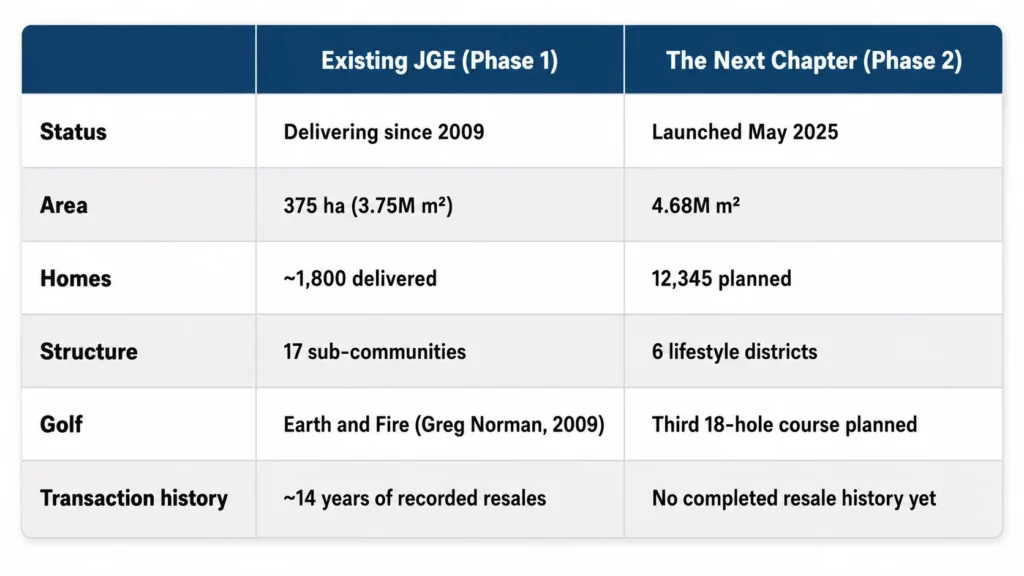
This is the most important comparison for anyone weighing the investment.
What actually changes
Phase 2 is roughly 1.25 times the land area of Phase 1 but plans for approximately seven times the number of homes. On completion, the original community would represent about 13% of the combined total.
That is not an extension. It is a redefinition of what the name Jumeirah Golf Estates refers to.
Why the existing track record genuinely matters
Most Dubai off-plan purchases require underwriting two unknowns at once: will the developer deliver, and will the location perform? Buying adjacent to a functioning community removes some of the second.
Phase 1 has approximately fourteen years of recorded resale transactions. Comparable evidence exists, how villas at this address have actually traded, how the community held up across more than one market cycle, what golf frontage commanded versus interior plots. You can ground assumptions in observed transactions rather than developer projections. That is a materially better analytical position than a greenfield launch offers.
The honest counterweight
Phase 1’s history is evidence, not a guarantee. It describes a low-density community of ~1,800 homes with mature landscaping. What Phase 2 creates, 12,345 homes, 51,700 residents, high-rise apartments, a rail terminus, a shopping complex, is a structurally different product. Phase 1 data tells you how a scarce, low-density golf address performs. It does not automatically tell you how a large, mixed-density, transit-anchored district will perform. Treat it as a useful prior requiring adjustment, not a read-across.
Cedarwood Estates South: The Current Release
Cedarwood Estates South is a limited release of 74 fairway villas on the southern side of The Next Chapter, between Mohammed Bin Zayed Road and Zayed Bin Hamdan Road, overlooking a 960,164 m² golf and sports realm.
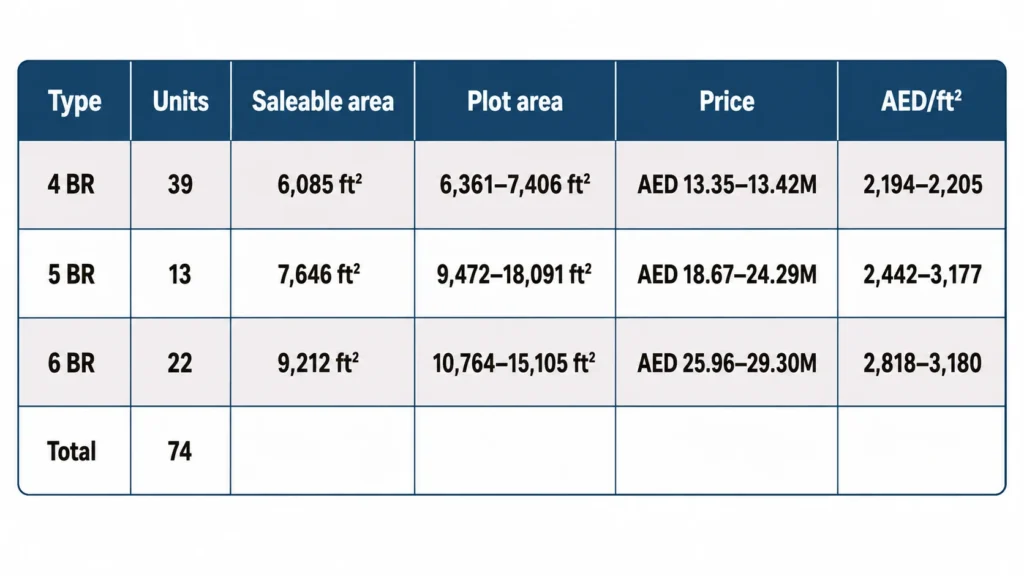
Specification and terms
- Building form G+1+R, maximum height 14 m
- 3 covered parking spaces
- 50/50 payment plan, 10% booking amount
- Handover Q1 2029
Each villa includes a double-height foyer and an elevator, floor-to-ceiling windows with golf views, a fitted kitchen with island and walk-in pantry, en-suite bedrooms, office, laundry, maid’s suite, private pool and landscaped courtyard, VRF ducted cooling, integrated home automation and porcelain flooring. Services include Country Club membership, concierge, security control, EV charging provision, dedicated waste management and guest valet parking.
The district plan features villas along an internal circulation loop, “Green Islands” of sculpted mounds and terraced planting, Sikka Gardens, cycle and jogging tracks, and shaded seating throughout.
Keep it in proportion
74 villas represent roughly 0.6% of the 12,345 homes planned. This is one limited release, not the total villa supply of The Next Chapter.
Price Positioning: How The Next Chapter Compares to Phase 1
This is the most analytically useful data available, because it lets a new-build price be tested against actual resale evidence at the same address.

What the numbers actually say
Only the 4-bedroom enters below the Phase 1 resale average, by approximately 6% to 12%, depending which end of the resale range you use. We checked this arithmetic against the stated figures and it holds.
The 4-bedroom is therefore the entry point of the release in price-per-square-foot terms, and it is also the largest allocation at 39 of 74 units. An investor whose thesis rests on buying below established resale evidence is, on this data, looking at one specific product type.
Keep it in proportion
74 villas represent roughly 0.6% of the 12,345 homes planned. This is one limited release, not the total villa supply of The Next Chapter.
The 5- and 6-bedroom villas price at a premium to the resale average. The brochure attributes this to larger plots ( up to 18,091 ft² ) and uninterrupted fairway frontage. That is a defensible rationale: plot size and frontage are the two attributes that most consistently separate prime villa pricing from average, and neither can be added later.
Both large types remain well below the 4,205/ft² prime-frontage figure, the 6-bedroom by roughly 24% to 33%, and the 5-bedroom across a wider span of roughly 24% to 42%, reflecting its unusually broad plot range. Whether that gap represents room to appreciate depends entirely on whether the new villas are genuinely comparable to whatever achieved 4,205.
Competing supply inside the same boundary

The brochure states that Ashwood Estates and Cedarwood Estates sold out in under 48 hours. It makes no such claim for Cedarwood Estates South.
Rapid launch absorption demonstrates real demand at launch pricing. It does not demonstrate resale liquidity, a different market, tested at a different time, against different competition. Those are the transactions that determine your exit, and no data on them exists yet for Phase 2.
Note the clustering too: multiple villa projects handing over between Q4 2028 and Q4 2029. Anyone planning to sell or lease on handover should assume they will not be doing so alone.
The Developer: wasl
wasl is described as one of Dubai’s largest real estate asset management groups, operating under a mandate from the Government of Dubai and active since 2008.
The portfolio also spans 8 community malls, 1,000+ buildings, 150+ restaurants and 8+ golf clubs.
Developer profile matters in off-plan because you are extending unsecured credit against future delivery. Two features here are relevant. First, operational scale, a group managing 60,000+ units and 35+ hotels is an asset operator, not solely a merchant builder, which aligns its interests with long-term community performance rather than sell-and-exit. Second, government mandate, which speaks to institutional durability across market cycles.
Neither eliminates delivery risk. Verify escrow arrangements and RERA project registration independently.
Is Jumeirah Golf Estates The Next Chapter a Good Investment?
There is no honest yes-or-no answer. There is a thesis with identifiable strengths and identifiable vulnerabilities, and its suitability depends on the horizon and objective you bring to it.
1. Established brand and community
Strength: Buying adjacent to a delivered, functioning community with fourteen years of resale evidence is a fundamentally different risk profile from a greenfield masterplan. The golf courses exist. The tournament happens. Residents live there. Some classic master-community risk (that the amenities never materialise) is already retired for the shared components.
Vulnerability: The specific Phase 2 components you may be buying for, the third golf course, the Mandarin Oriental, the tennis stadium, the school, do not yet exist. Phase 1’s record is encouraging evidence about execution, not a guarantee of these particular assets.
2. Villa and golf community supply
Golf-frontage plots are inherently constrained: they require a golf course, and courses require land plus continuing operational commitment. Once a course is built and its fairways lined with homes, frontage supply is permanently fixed.
That said, this masterplan is itself adding substantial villa supply, Cedarwood South’s 74 alongside Ashwood’s 185, Cedarwood’s 120, plus Pinewood, Terra Golf Collection 2 and D Villas, with more releases to come across 12,345 planned homes. Scarcity claims should be made at the level of specific attributes, direct fairway frontage, a large plot, a particular orientation, not the community as a whole. Broad scarcity is not supportable here.
3. Infrastructure
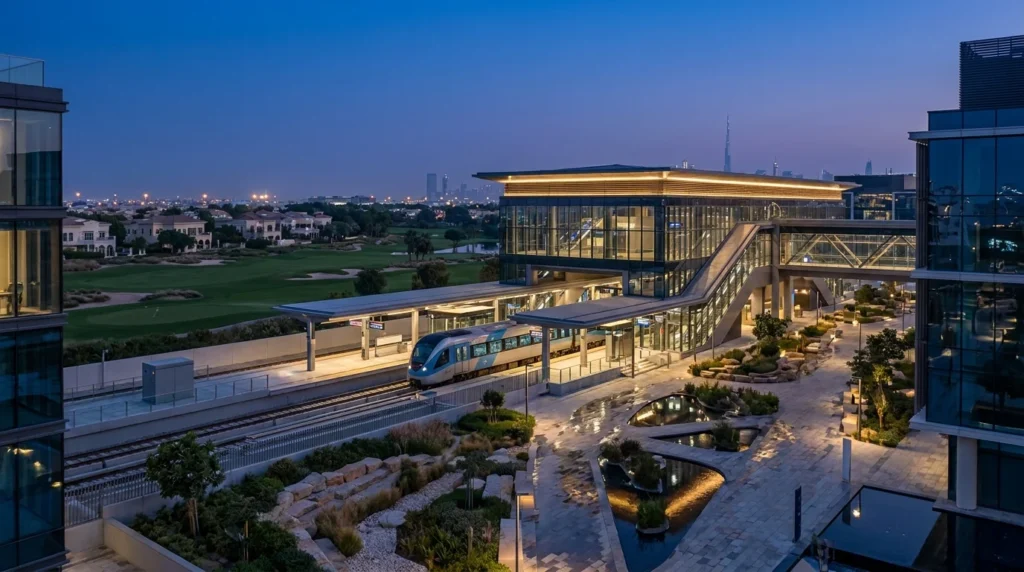
Three rail assets converging on one address, with a national terminus inside the boundary, is genuinely differentiated. Infrastructure that expands a location’s accessible catchment tends to be among the more durable drivers of long-term value.
The qualifier: two of the three are future-dated, both are developer-stated, and the most transformative (Gold Line, 2032) arrives years after the current release’s Q1 2029 handover. A thesis that requires the Gold Line is a thesis with a long, uncertain gap in the middle.
4. End-user demand
The masterplan is built around household formation: international school, health facility, mosques, retail, parks, sports facilities, and a stated 4.2 residents per home. End-user-led communities generally show steadier occupancy and lower churn than investor-led ones, because moving is disruptive to a family in a way it is not to a single tenant.
For a landlord this suggests stability rather than yield maximisation. The brochure provides no rental data, and we will not manufacture any. Rental demand and achievable rents must be researched separately using actual leasing evidence from Phase 1.
5. Luxury positioning
A five-star Mandarin Oriental with branded residences, three championship golf courses, a 5,000-seat tennis stadium and an equestrian centre constitute a credible premium amenity stack. Hotel operators of that tier apply their own location diligence, which functions as third-party validation.
The tension: the same masterplan contains high-rise apartments and a shopping complex around a rail terminus. This is a mixed community with a premium tier, not a uniformly ultra-luxury enclave. Arguably better for liquidity and retail viability, but not what “exclusive golf community” usually connotes.
6. Long-term development horizon
Advantage: Early entrants buy before amenities are delivered, and amenity delivery is one mechanism by which master communities re-rate. You are compensated for accepting construction-phase uncertainty.
Disadvantage: 12,345 homes take years to build out, years of construction activity, phased amenity delivery, and most significantly, a developer continuing to launch new stock at the same address while you may be trying to sell. Competing against a developer with a marketing budget, fresh product and flexible payment plans is structurally difficult for an individual reseller. This is the single most underappreciated risk in large-masterplan off-plan investment.
7. Resale and exit strategy
The 50/50 plan on Cedarwood South with 10% booking means roughly half the price falls due across a construction period running to Q1 2029, with the balance at handover. Pinewood offers 80/20 and Ashwood 10/40/50, structures differ materially by project, and directly determine your capital exposure profile and realistic exit point.
Before committing, establish: what you would need on resale to clear entry price plus costs; who the buyer would be at that point; and what else will be available at the same address on that date.
What Should Investors Check Before Buying?
Use this as a working due-diligence checklist. The brochure answers some of these. Several it does not, and those gaps are where advisory work earns its value.
Pricing and comparables
- Price per square foot on saleable area versus Phase 1 recorded resales, not asking prices
- A broader comparable set than the single AED 4,205/ft² Redwood Avenue reference
- Pricing against competing golf and villa communities elsewhere in Dubai, not only within JGE
- Whether the unit sits at the favourable end of its type’s price band
Supply and timing
- How many further releases are planned inside the masterplan, and on what schedule
- Handover clustering, several projects land Q4 2028 to Q4 2029
- Construction milestones, escrow arrangements and RERA registration
- Contractual remedies if handover slips
The specific unit
- Plot size within the stated range, 5-bedroom plots span 9,472 to 18,091 ft², a near-doubling that should be reflected in price
- Orientation and views, genuine uninterrupted fairway frontage versus partial or oblique outlook
- Position relative to the transit-oriented district, main roads and construction phasing
- Proximity to amenities, and which of them exist on your handover date
Ongoing costs and returns
- Service charges, not stated in the brochure, and material to net returns on large villas with extensive shared landscaping, golf infrastructure and club facilities. Request the projected schedule in writing.
- Country Club membership terms: what is included, what recurs, and whether it transfers on resale
- Actual rental evidence from comparable Phase 1 villas, if you intend to lease
Exit
- Recorded resale volumes and time-on-market for Phase 1 villas
- Realistic buyer profile at your intended exit date
Transfer and agency costs, and any developer restrictions on resale before handover
Who Should Consider Investing Here?
Long-term investors with a multi-year horizon. The infrastructure and amenity thesis unfolds over years, Q1 2029 handover, a 2032 Gold Line. Capital that must be liquid inside three years is poorly matched to this asset.
Villa and low-density specialists. Investors who understand that villa investment is driven by plot, frontage and orientation rather than headline finish, and who can price those attributes.
End-user families. The school, health facility, parks, sports infrastructure and golf make this a live-in proposition. Buyers who will occupy the home are insulated from the timing risk that most affects pure investors.
Buyers prioritising capital appreciation over immediate income. No rental data exists for Phase 2, and construction-phase assets generate nothing. This suits investors positioning for community maturation rather than day-one yield.
International buyers seeking an established Dubai address. Fourteen years of transaction history, a contracted professional tournament and a government-mandated developer offer more grounding than a first-generation launch.
Keep it in proportion
74 villas represent roughly 0.6% of the 12,345 homes planned. This is one limited release, not the total villa supply of The Next Chapter.
Final Investment Perspective
Jumeirah Golf Estates The Next Chapter presents a more analytically tractable proposition than most Dubai off-plan launches, because it attaches to something real. Phase 1 supplies fourteen years of resale evidence, two operating golf courses and a tournament contracted to 2031. That is a firmer foundation than a rendering and a masterplan.
The complications are equally real. The second phase is roughly seven times the first in unit count and will materially change the character of the address. A meaningful share of the value case rests on infrastructure with developer-stated future dates. Only the 4-bedroom at Cedarwood South enters below the Phase 1 resale average, and the premium benchmark most often cited rests on a single asset. And an investor buying today should expect to eventually resell into a market where the developer is still launching competing stock.
None of that argues against the investment. It argues for buying the right unit at the right price with a realistic horizon, and for treating the brochure as the beginning of the analysis rather than its conclusion.
FAQ
What is Jumeirah Golf Estates The Next Chapter?
The Next Chapter is the second phase of Jumeirah Golf Estates in Dubai, a 4.68 million m² masterplan launched in May 2025, adjacent to the original community. It is planned to deliver 12,345 new homes for approximately 51,700 residents across six lifestyle districts, with 1.51 million m² of green and open space.
Who is developing Jumeirah Golf Estates The Next Chapter?
wasl is the developer behind the masterplan and its current villa releases, including Cedarwood Estates South, Cedarwood Estates, Ashwood Estates and Pinewood Estate Homes. wasl operates under a mandate from the Government of Dubai and has been active since 2008. Other developers are also active within the boundary, Taraf (Terra Golf Collection 2) and DarGlobal (D Villas).
Where is Jumeirah Golf Estates located?
In Dubai’s Me’aisem area, with access via four highway corridors: E311 (Sheikh Mohammed Bin Zayed Road), D57 (Al Yalayis Street), D59 (Al Jamayel Street) and E44 (Al Khail Road). Stated drive times include 8 minutes to Al Khail Road, 10 to Dubai Hills Mall, 15 to Sheikh Zayed Road and 25 to Downtown Dubai.
Is Jumeirah Golf Estates connected to the Dubai Metro?
Yes. JGE Metro Station has been open since 2021 on Route 2020, two stops from Expo City. The developer additionally states that a Dubai Al Yalayis Station serving as an Etihad Rail main hub is planned for 30 September 2026, and that the Metro Gold Line (a 42 km underground line) will terminate at JGE in 2032. Both future dates are developer claims and should be independently verified.
What is the difference between Jumeirah Golf Estates and The Next Chapter?
Existing Jumeirah Golf Estates covers 375 hectares with 17 sub-communities and roughly 1,800 delivered homes, plus the Earth and Fire golf courses. The Next Chapter is the newer, adjacent phase, 4.68 million m² with 12,345 planned homes. Phase 1 is built and trading; Phase 2 is largely under development. On completion, Phase 1 would represent around 13% of the combined community.
What types of properties are available in The Next Chapter?
The masterplan includes villas, townhouses, branded residences and high-rise apartments within its transit-oriented district. Current releases include Cedarwood Estates South (74 four-to-six-bedroom golf villas from AED 13.35M), Pinewood Estate Homes (three- and four-bedroom townhouses from AED 5.70M), Terra Golf Collection 2 branded residences and D Villas. Hilltop Mansions are planned at the centre of the third golf course district.
Are villas available in The Next Chapter, and what do they cost?
Yes. Cedarwood Estates South offers 74 fairway villas: 4-bedroom (6,085 ft² saleable) at AED 13.35–13.42M, 5-bedroom (7,646 ft²) at AED 18.67–24.29M, and 6-bedroom (9,212 ft²) at AED 25.96–29.30M. Terms are a 50/50 payment plan with 10% booking and Q1 2029 handover. Availability and pricing change, confirm current figures before proceeding.
Is Jumeirah Golf Estates suitable for families?
The masterplan is designed around family occupancy. Planned components include an international school in the Village District, an onsite health facility, three mosques, a 131,850 m² Central Park, 1.51 million m² of green and open space, a Town Centre mall with 48,000 m² of retail and dining, an equestrian centre, a tennis stadium and extensive sports facilities. The planning assumption of roughly 4.2 residents per home reflects a family-oriented community. Note that several of these amenities are planned rather than delivered.
Can foreigners buy property in Jumeirah Golf Estates?
Dubai permits foreign nationals to own property outright in its designated freehold areas, and the development brochure markets Jumeirah Golf Estates to international buyers. Ownership tenure is not specified in the brochure, however, and eligibility, visa and residency rules are periodically updated, so confirm the tenure of the specific unit and your current eligibility with a qualified advisor before transacting.
Considering Jumeirah Golf Estates? Let’s pressure-test the numbers.
In a masterplan of this scale, the difference between a good and a poor outcome is rarely the decision to buy. It is unit selection, entry price, and timing.
- Project analysis — masterplan components, phasing and delivery risk
- Unit selection — plot, orientation, frontage and position within the masterplan
- Price comparison — benchmarking against recorded transactions at the address and in competing communities
- Transaction analysis — resale evidence, absorption and comparable pricing
- Investment strategy — matching payment structure, holding period and exit plan to your objectives