

Why the most-quoted figure in the villa market is also the most misleading, and how to read a villa’s real value in 2026.
Almost every villa conversation I have starts the same way. Someone sends me two listings and asks, “This one is AED 2,100 a square foot and that one is AED 2,500, so the first is the better deal, right?”
It is the most reasonable question in the world, and the answer is almost always no.
Price per square foot is the number the whole market leans on, because it feels objective. One figure, easy to compare, hard to argue with. But for villas specifically, it hides more than it reveals. Two homes at the “same” price per square foot can differ by millions in real value, and the buyer who trusts the headline number is usually the one who overpays. Let me show you why, and what to look at instead.
What “price per square foot” actually measures
Here is the first problem: the square footage in that calculation is almost never the space you live in.
When a developer or portal quotes a villa, the area is usually the built-up area (BUA), and BUA includes a lot of things that are not living space. External and internal wall thickness. Covered terraces and balconies. Stairwells. Often the garage. The headline says 5,500 sq ft; the space you actually walk around in is closer to 4,100. The rest is structure.
That gap matters because two villas with identical BUA can give you very different homes. One might be efficiently designed with generous rooms; the other might waste a quarter of its “size” on thick walls, oversized circulation and a double-height void that looks dramatic but houses no one. On paper they cost the same per square foot. In reality you are paying the same money for meaningfully less.
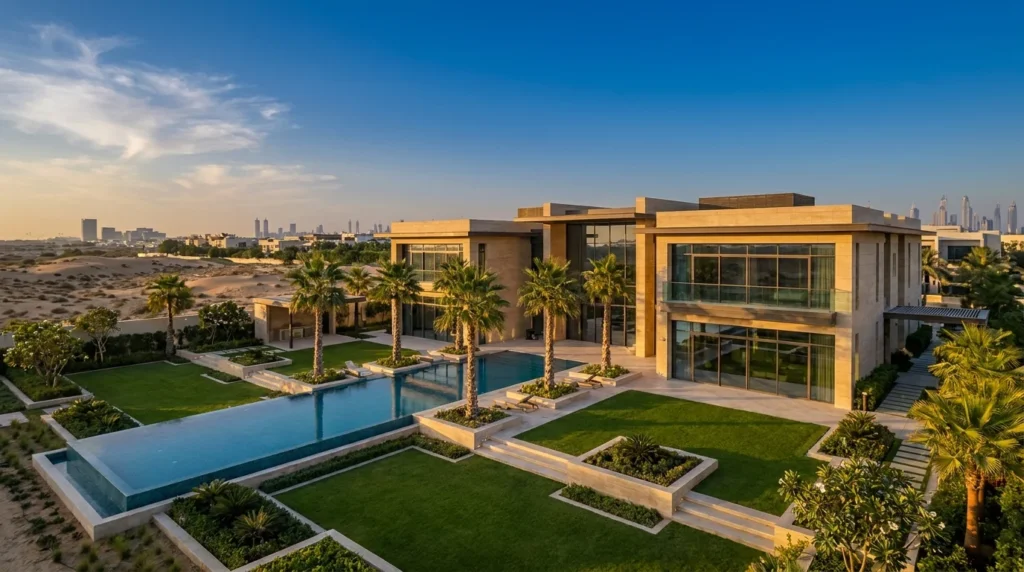
BUA vs GFA vs plot: the three numbers that actually decide value
To read a villa properly, you need to separate three figures that get blurred together:
Built-Up Area (BUA)
the total constructed area, walls and covered outdoor spaces included. This is the number used in most price-per-square-foot quotes, and it flatters the property because it is the largest of the three.
Gross Floor Area (GFA)
the regulated floor area Dubai Municipality uses to govern how much can be built on a plot (through the floor-area ratio). It generally excludes balconies and often parking, so it is closer to genuine internal space than BUA.
Plot area
the land itself, independent of what sits on it. For villas, this is the part most buyers underweight and the part that drives long-term appreciation.
The single most useful habit you can build is to ask for all three on every villa, then judge price against the two that matter, usable internal space and plot, rather than the inflated BUA figure the market hands you.
The number nobody quotes: price per square foot of land
Here is the insight that changes how you shop. In Dubai, villa appreciation is overwhelmingly a land story. The city has added apartments at extraordinary speed, but villa supply is structurally tight, villas have made up only around a fifth of new handovers, and they take far more land, time and capital to deliver. When something scarce stays in demand, the scarce ingredient is the land under it, not the plasterboard on top.
That is why villas have pulled away from apartments. Through 2026, villa values rose roughly 9.9% year-on-year against about 5.5% for apartments, the price gap between the two segments widened to around AED 505 per sq ft, and ValuStrat has forecast villa values rising close to 18% over the year while citywide capital values rise about 10%. More than 65% of villa buyers are now end-users buying to live, not flip, which tells you this demand is durable, not speculative.
So when you compare two villas, do the calculation the market doesn’t show you: price ÷ plot area. It often flips the “obvious” winner on its head.
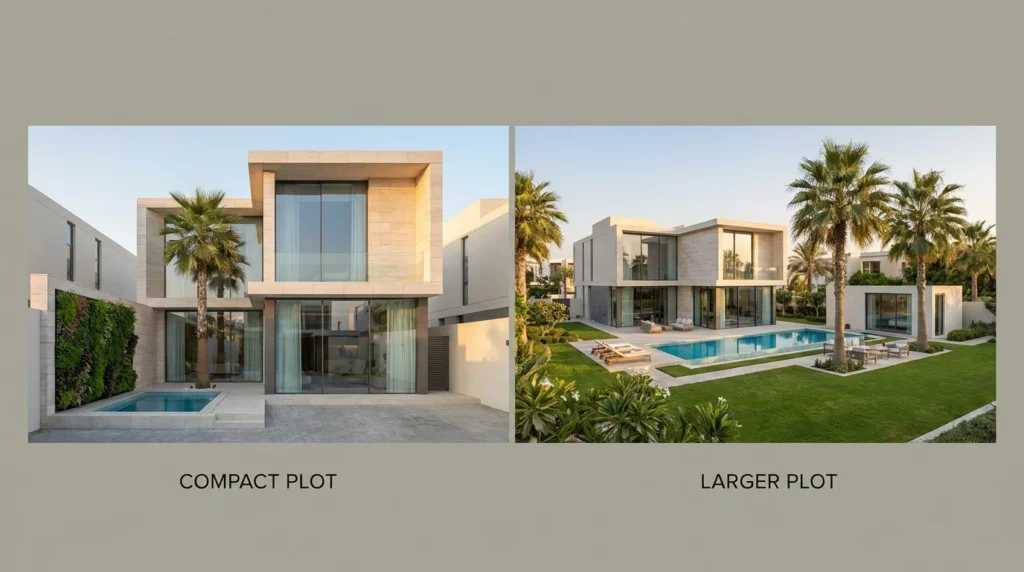
A worked example: the cheaper villa that costs more
Two villas, near-identical price, very different value. These are illustrative figures in the range of established Dubai villa communities in 2026.
| Villa A (looks cheaper) | Villa B (looks pricier) | |
| Quoted price/sq ft (BUA) | AED 2,100 | AED 2,500 |
| BUA | 5,500 sq ft | 4,600 sq ft |
| Total price | AED 11.55M | AED 11.50M |
| Plot size | 6,000 sq ft | 9,500 sq ft |
| Usable internal space (approx.) | ~4,070 sq ft (74% efficient) | ~3,910 sq ft (85% efficient) |
| Price per sq ft of plot | AED 1,925 | AED 1,210 |
The headline price per square foot didn’t just fail to capture this. It pointed you in the wrong
The reality check the bank will give you anyway
There is one more reason not to anchor on a developer’s price-per-square-foot: your lender won’t. UAE banks lend against a certified valuer’s assessment of what a home is genuinely worth, not against a brochure or an asking price. If a seller has priced optimistically on a flattering BUA figure, the valuation can come in lower, and the gap becomes cash you have to find yourself.
In other words, the market already has a mechanism for separating real value from marketing; it just arrives late, after you’ve fallen for the listing. You are better off applying that discipline before you make the offer.
How to read a villa’s real value: a buyer’s checklist
Before you compare two villas on price per square foot, get these in writing and run the math yourself:
- Ask for BUA, GFA and plot area separately. If an agent can only give you BUA, that tells you something.
- Estimate usable internal space. A well-designed villa converts most of its BUA into living area; an inefficient one loses 25%+ to walls, voids and circulation.
- Calculate price per square foot of plot, not just BUA. Land is the appreciating asset.
- Weigh the plot’s quality, not only its size — orientation, single-row vs. back-to-back, and what it backs onto all move resale.
- Sense-check against a bank valuation before you’re emotionally committed, especially on a resale priced above recent comparable transactions.
- Treat the headline price per square foot as a starting question, never the answer.
Sometimes, but only by coincidence. Price per square foot is a blunt instrument the market loves because it’s simple, and simple is exactly what gets buyers into trouble on an asset as varied as a villa. The homes that perform are the ones with efficient layouts on generous, well-positioned land, and that combination almost never reveals itself in a single headline number.
The good news is that the discipline here is learnable, and once you see villas this way, you cannot unsee it. If you’re weighing two or three options and want a second read, BUA versus usable space, plot value, and where each sits against recent sold prices, that’s exactly the kind of comparison I do with buyers before they make an offer.

FAQ
What is a good price per square foot for a villa in Dubai in 2026?
There isn’t a single “good” number, because it depends entirely on the community and the plot. As a reference, villas average roughly AED 2,200+ per sq ft citywide, with established family communities like Dubai Hills Estate and Arabian Ranches around AED 2,200–2,300, and prime addresses such as Palm Jumeirah and Emirates Hills running far higher. More useful than the average is whether the figure is quoted on BUA or usable space, and what you’re paying per square foot of land.
What’s the difference between BUA, GFA and plot area?
BUA (built-up area) is the total constructed area including walls, covered terraces and often the garage, the largest and most flattering figure. GFA (gross floor area) is the regulated area Dubai Municipality uses for plot ratios and usually excludes balconies and parking, so it’s closer to real internal space. Plot area is the land itself. Most price-per-square-foot quotes use BUA, which is why they overstate value.
Why are villas outperforming apartments in Dubai?
Mainly scarcity of land. Apartments have been delivered in huge volumes, while villas remain a small share of new supply and take more land and time to build. With strong, largely end-user demand, that imbalance pushed villa values up roughly 9.9% year-on-year versus about 5.5% for apartments, and forecasters expect villas to keep outperforming through 2026.
How do I know if a villa is overpriced?
Compare it three ways: price per square foot of usable internal space (not BUA), price per square foot of plot, and recent sold prices for genuinely comparable homes in the same community. If the asking price only looks reasonable on the BUA figure and stretches on the other two, it’s likely priced for the seller, not the market, and a bank valuation will often confirm it.
Does the developer’s quoted size match what I actually get?
Rarely, exactly. A villa quoted at, say, 5,500 sq ft BUA might deliver closer to 4,100 sq ft of genuine internal living space once walls, terraces, stairs and structure are removed. Always ask how the area was measured before you compare two homes on price per square foot.