
Ask two investors why they chose a particular Dubai community and you will often hear two entirely different answers. One bought where the ticket price was lowest. The other bought where the rental return looked strongest. Both were reading half the picture.
A headline price tells you what it costs to get in. A yield figure tells you what the asset may generate. Neither number means much in isolation, because the same budget can buy a very different investment depending on where it lands, and the highest advertised return does not automatically produce the highest income in your pocket once costs, occupancy and resale conditions are accounted for.
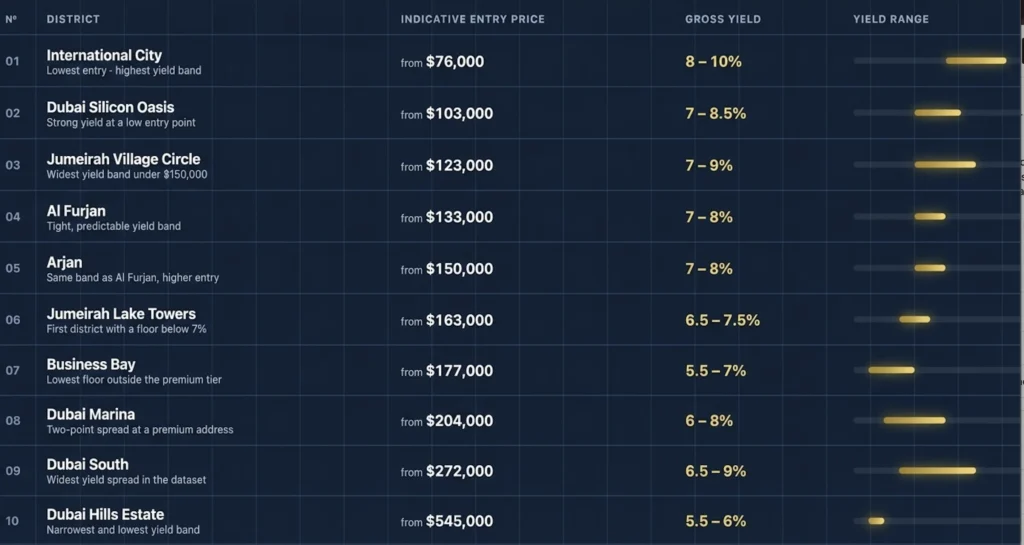
This guide compares ten Dubai districts on the two variables that decide most purchase decisions: the indicative minimum entry price and the typical gross rental yield. The figures come from a single market dataset covering average gross yields for 2026, so they are directly comparable with one another, a genuine advantage when assessing the Dubai property market, where quoted returns often come from inconsistent sources.
Before you scan the table, one framing point. When comparing property investment in Dubai, weigh at least six things together: minimum entry price, the property type that budget realistically buys, the gross yield range, tenant demand, community maturity, and holding costs such as service charges. The dataset behind this article covers the first and third of those directly. The rest should be confirmed against live listings and building-level information before you commit.
A note on how to read the figures
Every yield quoted here is a gross figure, rental income measured against purchase price, before service charges, management fees, maintenance, vacancy periods or transaction costs. Net returns will sit lower, and the gap between gross and net varies considerably from one building to another. Entry prices are indicative starting points in US dollars, representing the lower boundary of the market in each district rather than an average or a guaranteed asking price.
Quick Comparison Table: Dubai Entry Prices and Rental Yields
Best Dubai Areas for Lower Entry Budgets
Three districts sit below $135,000: International City (~$76,000), Dubai Silicon Oasis (~$103,000) and JVC (~$123,000), with Al Furjan close behind at ~$133,000.
What makes this group notable is that low entry price and low yield do not go together here, quite the opposite. All four carry a yield floor of 7% or above, and three of them reach a ceiling of 8.5% or higher. In this dataset, the cheapest districts also carry the strongest gross returns.
That said, entry-level buyers should be clear about what the data does not tell them. The source provides no information on unit sizes, building quality, service charge levels, tenant profiles or future supply in these districts, and all of those factors weigh more heavily at the affordable end of a market, where running costs consume a larger share of gross rent. A 9% gross yield on a small unit with high service charges can net out below a 6% yield on a larger one.
Practical guidance: at lower budgets, prioritise verifying service charges and realistic occupancy before comparing headline yields. The gross figures in this table are a starting filter, not a ranking.

Best Dubai Areas for Rental Yield
Ranked by the upper boundary of each yield band:
- International City — 8% to 10%
- Dubai South — 6.5% to 9%
- JVC — 7% to 9%
- Dubai Silicon Oasis — 7% to 8.5%
- Al Furjan, Arjan, Dubai Marina — reaching 8%
Ranked by the floor of each band, arguably the more useful measure for investors who cannot guarantee they will buy at the top of a range, the picture reorders. International City (8%) leads clearly, followed by four districts at 7%: DSO, JVC, Al Furjan and Arjan. Dubai Marina’s floor sits at 6%, despite an 8% ceiling.
This distinction matters. A wide band such as Dubai South’s 6.5–9% or Dubai Marina’s 6–8% offers real upside but also real dispersion, the outcome depends heavily on which specific asset is purchased. A narrow band such as Al Furjan’s 7–8% or Dubai Hills Estate’s 5.5–6% offers less upside but more certainty.
A necessary caution. The highest yield in this table is not automatically the best investment. Every figure quoted is gross, and the source data contains nothing on service charges, occupancy rates, management costs, future supply or resale liquidity, all of which sit between a gross yield and an investor’s actual return. A district leading on gross yield may or may not lead on net yield. That comparison requires information beyond this dataset.
Best Areas for Capital Appreciation Potential
Here, honesty serves the reader better than speculation.
The supplied dataset contains no capital appreciation data. It reports gross rental yields and indicative entry prices for 2026, nothing on historical price growth, transaction volumes, supply pipelines, infrastructure timelines or forward projections. Any claim in this article about which Dubai communities will appreciate fastest would be invention rather than analysis, and no such claim is made.
What the data does show is a clear inverse relationship: the districts with the highest entry prices carry the lowest gross yields, and vice versa. Dubai Hills Estate at ~$545,000 returns 5.5–6%; International City at ~$76,000 returns 8–10%. That pattern is common in property markets, and it is often (though not always) associated with different balances between income return and capital value. But the dataset does not confirm the reason for the pattern in Dubai’s case, and no appreciation outcome should be inferred from it.
Investors weighing capital growth should request current transaction and price-trend data before deciding. Behniya can provide district-level historical performance and current market indicators to sit alongside the yield figures presented here. Past performance, in any case, does not guarantee future results.

Ready Property vs Off-Plan Investment
The supplied dataset does not indicate whether the quoted entry prices refer to ready or off-plan property, and the distinction changes the investment case substantially.
Why it matters. Ready property can generate rental income immediately, which means the quoted gross yield begins applying from completion of the purchase. Off-plan property typically involves staged payments over a construction period, defers rental income until handover, and carries delivery timing risk, but usually requires less capital upfront at the point of commitment.
Because the source data is silent on this point, the entry prices in the comparison table should be treated as indicative purchase prices without assuming either category. Establishing the status of a specific unit is one of the first questions to ask when shortlisting, since two units at an identical headline price can have entirely different cash flow profiles depending on whether one is income-producing today and the other is two years from handover.
Current availability, payment structures and handover timelines should be confirmed on a per-project basis.
How to Choose the Right Dubai Community
Use the figures in this guide as a filter, then work through the following before committing:
- Total available budget — including reserves, not just the purchase price.
- Down payment and purchasing costs — transaction fees, registration and agency costs sit on top of the entry price.
- Minimum entry price — confirm the district’s floor reflects a unit you would actually want to own.
- Expected gross yield — and where within the quoted band a specific unit realistically sits.
- Gross versus net return — the single most common source of disappointment in yield-led purchases.
- Service charges — not covered in this dataset, and capable of moving a net return by several percentage points.
- Tenant profile and demand — who rents in this district, and how consistently.
- Property type — a studio, one-bedroom, townhouse and villa behave differently as investments.
- Ready versus off-plan status — immediate income or deferred income with staged payments.
- Investment horizon — short-hold and long-hold strategies favour different districts.
- Exit strategy — who buys this asset from you, and how quickly.
- Risk tolerance — a wide yield band means dispersion in both directions.
Two principles are worth stating plainly. The lowest entry price does not always produce the strongest investment result, a cheap asset with high running costs and thin demand can underperform a more expensive one. Equally, the highest advertised gross yield does not always produce the strongest net return, for exactly the same reasons in reverse.

Suggested Areas by Investor Type
Based only on the entry price and gross yield data supplied:
- Lowest capital requirement: International City (~$76,000), Dubai Silicon Oasis (~$103,000)
- Highest gross yield ceiling: International City (10%), Dubai South (9%), JVC (9%)
- Highest gross yield floor: International City (8%), then DSO, JVC, Al Furjan and Arjan (all 7%)
- Most consistent yield range: Dubai Hills Estate (0.5-point band), Al Furjan, Arjan and JLT (1-point bands)
- Widest range for active selectors: Dubai South (2.5 points), JVC and Dubai Marina (2 points each)
- Upper-budget entry points: Dubai South (~$272,000), Dubai Hills Estate (~$545,000)
Suitability by tenant demand, family appeal, short-term rental potential or off-plan availability cannot be assessed from the supplied data and has therefore been left out. These groupings reflect price and yield only.
Conclusion
Ten districts, entry prices ranging from roughly $76,000 to $545,000, and gross yields spanning 5.5% to 10%, the spread across Dubai’s investment market is wide enough that no single figure can guide a decision.
The clearest pattern in the data is the inverse relationship between price and yield. International City combines the lowest entry point with the highest gross return; Dubai Hills Estate does the reverse. Between them sit districts making different trade-offs, and the most useful ones for many investors are the middle cases (JVC, Dubai Marina and Dubai South) where wide yield bands mean that careful asset selection, rather than district selection alone, drives the outcome.
Read entry price and yield together, and read both as starting points. Every figure here is gross and indicative. What an individual unit actually returns depends on its building, size, floor, view, condition, furnishing, service charges, handover status and the market conditions at the time of purchase, none of which a district-level table can capture.
Prices and rental returns differ significantly from one building to the next, and often from one unit to the next within the same building. If you would like a shortlist built around your budget, preferred property type and return objectives, with current availability, verified service charges and a gross-to-net yield breakdown, get in touch with Behniya. We will provide an updated comparison based on live market data rather than headline averages.
FAQ
What is the minimum amount needed to invest in Dubai property?
Based on the supplied 2026 market data, the lowest indicative entry price among the ten districts compared is approximately $76,000 in International City. Dubai Silicon Oasis follows at approximately $103,000. These are starting points rather than averages, and purchasing costs sit on top of the property price.
Which Dubai area has the highest rental yield?
International City records the highest gross yield range in this dataset at 8% to 10%. Dubai South and JVC both reach a 9% ceiling. All figures are gross yields for 2026 and exclude service charges and running costs.
Is a high rental yield always a sign of a good investment?
No. Every yield quoted here is gross, meaning it excludes service charges, maintenance, management fees, vacancy periods and transaction costs. A district leading on gross yield will not necessarily lead on net return. Yield should be assessed alongside property quality, occupancy, holding costs and exit potential.
Which Dubai communities suit first-time investors?
On price and yield data alone, the districts with the lowest capital requirements are International City (~$76,000), Dubai Silicon Oasis (~$103,000), JVC (~$123,000) and Al Furjan (~$133,000). All four carry a gross yield floor of 7% or above. Al Furjan and Arjan have the narrowest yield bands in the lower-mid tier, which may suit investors who prefer predictability.
Should investors buy ready or off-plan property in Dubai?
The supplied dataset does not distinguish between ready and off-plan property, so no recommendation can be made from these figures. The difference is significant, ready property can generate rental income immediately, while off-plan typically involves staged payments and deferred income. Confirm the status of any specific unit before comparing prices.
Why does Dubai South have a higher entry price than Dubai Marina?
The supplied data lists Dubai South at approximately $272,000 and Dubai Marina at approximately $204,000, but does not explain the difference. It may reflect a different property type or unit size at entry level. Current figures should be confirmed based on unit availability and market conditions.
The yields above are gross. Strip out service charges, void periods and management fees and the ranking changes. Sometimes it reverses.
Entry prices move as well. That $76,000 is a starting point, not an asking price, and what’s on the market this week isn’t what was there last month.
So do this instead. Tell me your budget and what you want the property to do. I’ll come back with what’s actually available, what the service charge does to the headline yield, and which of these ten areas I’d leave alone at your number.
Send me your budget.