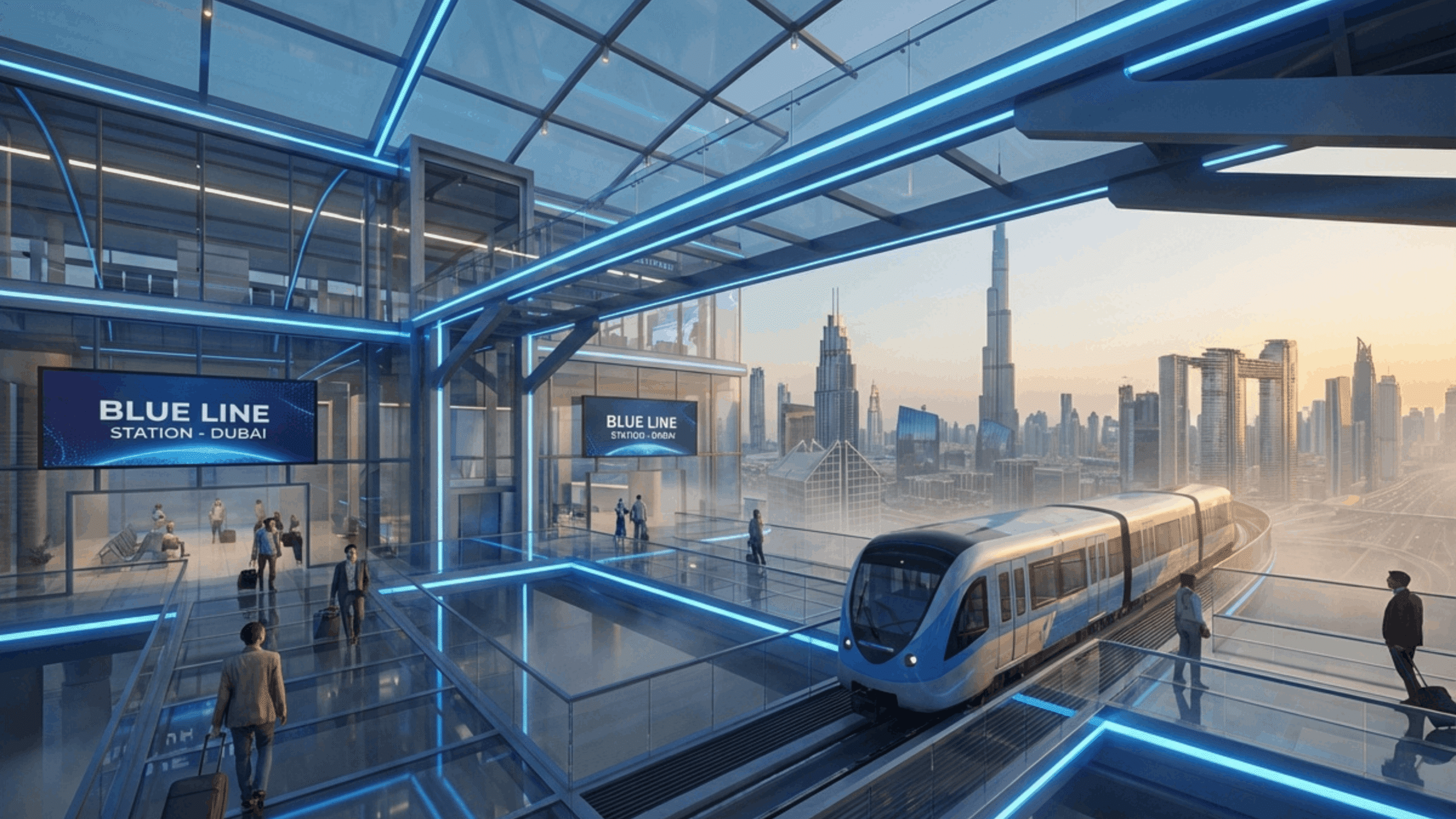
Dubai’s AED 18 billion Metro Blue Line is not just a transport project. It is the single largest infrastructure catalyst reshaping property values across the city’s eastern corridor — and the price adjustments have already begun.
Since Sheikh Mohammed bin Rashid Al Maktoum approved the Blue Line in November 2023, rents across the nine communities connected by the new line have surged by an average of 23%, according to data from Betterhomes and Property Monitor. Academic City alone recorded a 43% spike in studio rents. Dubai Silicon Oasis posted the highest price-per-square-foot jump across all Dubai apartment markets in 2025 at 29%.
The construction is now well underway. As of late 2025, the RTA confirmed 12% overall progress with more than 4.6 million work hours completed across 12 active sites. The target is 30% completion by end of 2026 and full operations on 9 September 2029. Mattar Al Tayer, RTA Director General, confirmed the project is anticipated to boost property values by up to 25% near stations and reduce traffic congestion by 20% along the served corridors.
But here’s what most analyses miss: not all Blue Line communities will appreciate equally. The properties that will gain 15–20% before 2028 share a specific profile — and this article breaks down exactly where the data points.
What the Historical Data Actually Shows
Before projecting forward, the precedent from Dubai’s existing metro lines is critical. The CBRE Dubai Metro Report 2023, which analysed nearly 74,000 sales transactions and 112,000 rental contracts along the Red Line, found that properties within a 15-minute walk of metro stations saw average price growth of 26.7% between Q1 2010 and Q4 2022 — outperforming the Dubai-wide average of 24.1%.
The strongest gains were not at the doorstep of stations. Properties in the 10–15 minute walking zone recorded the highest price growth at 43.8% on average. Rental growth followed the same pattern, with the 10–15 minute bracket recording 11.7% rental growth, while the Dubai average over the same period actually declined by 4.1%.
The RTA’s own published data shows that real estate located within a 1.5 km radius of the Red and Green Lines saw price increases ranging from 13% to 41%. Globally, properties within 500–800 metres of metro stations command premiums of 8–25%, depending on city maturity. Dubai’s results sit squarely in the upper range.
Key takeaway for Blue Line investors: The price uplift is real, measurable, and most pronounced in the 500m–1.5km radius around stations. Critically, the gains begin during construction — not after opening. The Blue Line has already entered this phase.
The Blue Line Route: 14 Stations, Two Corridors, One AED 56.5 Billion Impact
The Blue Line spans 30 kilometres with 14 stations running in two directions. The first route (21 km, 10 stations) starts at Creek Interchange Station on the Green Line in Al Jaddaf, passes through Dubai Festival City, Dubai Creek Harbour, and Ras Al Khor Industrial Area, continuing through International City 1, 2, and 3, Dubai Silicon Oasis, and ending at Academic City.
The second route (9 km, 4 stations) begins at Centrepoint Interchange Station on the Red Line in Al Rashidiya, passing through Mirdif and Al Warqa, connecting to the interchange station at International City 1.
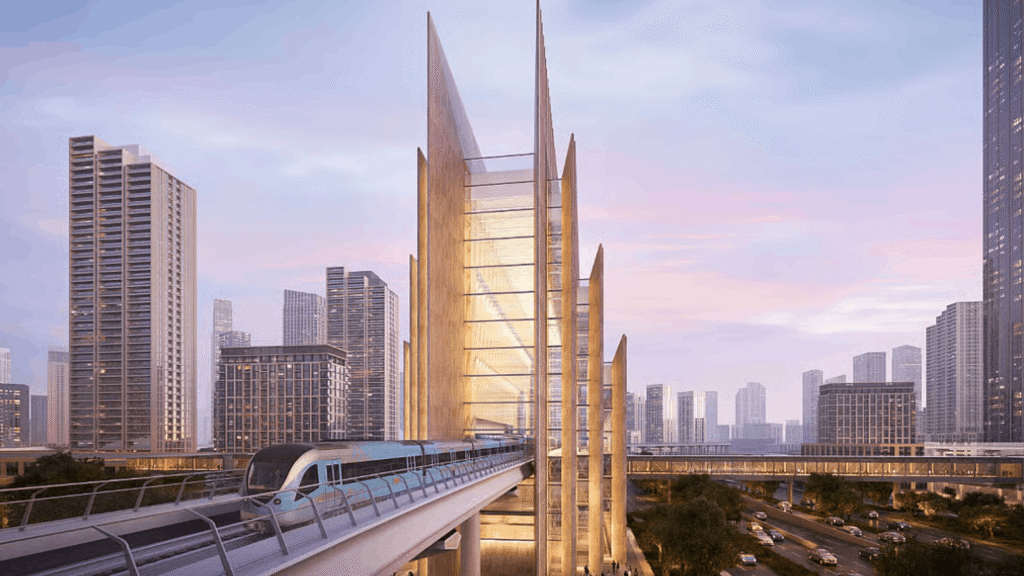
The project features 9 elevated stations and 5 underground stations, including the world’s tallest metro station at Dubai Creek Harbour — the Emaar Properties Station, designed by SOM (the architects behind Burj Khalifa), standing at 74 metres with capacity for 160,000 passengers daily. The International City 1 underground interchange station will span 44,000 square metres, becoming the largest underground metro station in the UAE.
The RTA estimates total economic benefits exceeding AED 56.5 billion by 2040, encompassing time savings, reduced fuel consumption, fewer accidents, and the property value uplift itself. The line is expected to serve areas housing approximately one million residents by 2040, carrying over 320,000 passengers daily.
Community-by-Community Breakdown: Where 15–20% Gains Are Most Likely Before 2028
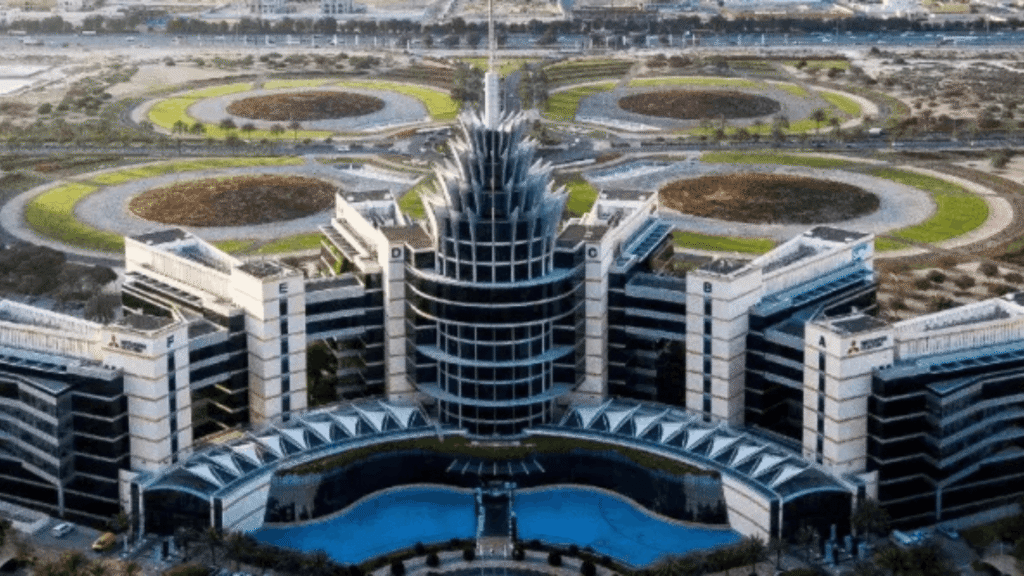
1. Dubai Silicon Oasis (DSO) — The Strongest Data Case
DSO has emerged as the single best-performing apartment market in Dubai for price appreciation in 2025. According to Bayut and Dubizzle’s year-end market report, DSO posted the highest price jump in per-square-foot terms at 29% — directly attributed to the Blue Line announcement. Rents have increased 28% since November 2023.
Farooq Syed, CEO of Springfield Properties, noted that DSO ranks among Dubai’s top 5 areas for investment yield on apartments, with rental returns between 7.5–9%. Current average annual rents sit around AED 76,500, with one-bedroom listings at approximately AED 66,000–80,000 depending on the tower.
Why 15–20% further upside is realistic: DSO is designated as Dubai’s fifth urban centre under the Dubai 2040 Master Plan. It currently lacks any metro connectivity, making the Blue Line a first-mover infrastructure event. The combination of tech-sector tenant demand, relatively affordable entry points (AED 550K–800K for 1-beds), and confirmed station placement creates a near-textbook transit premium scenario. The Sands of Wealth 2026 forecast projects 6–12% growth for DSO this year alone, with cumulative 5-year gains potentially reaching 30–45%.
2. Dubai Creek Harbour — The Iconic Station Premium
Dubai Creek Harbour has already recorded a 30% increase in property values since the Blue Line announcement, according to reporting by Khaleej Times. This area will be home to the world’s tallest metro station — the Emaar Properties Station — which alone generates significant marketing and perception value.
Current rental trends show one-bedroom apartments listing at AED 100,000+ per year, with two-bedroom units around AED 140,000. The community is backed by Emaar’s master plan, offering a waterfront, mixed-use environment with a distinct Downtown Dubai-quality feel.
Why further appreciation is expected: Industry expert Youssef, quoted in Khaleej Times, projected that Dubai Creek Harbour could see the highest increases among Blue Line communities due to the market’s focus on quality and integrated communities. The iconic station, combined with waterfront positioning and proximity to future commercial zones, positions Creek Harbour as a premium Blue Line play. However, entry prices are higher, so percentage gains may moderate compared to mid-market areas.
3. International City — The Yield Play
International City is one of the biggest Blue Line beneficiaries by sheer scale. The area will receive three dedicated stations plus the massive underground interchange station at International City 1. Rents have already increased 22% since November 2023, and the community already delivers some of the highest rental yields in Dubai at 9.7% for apartments.
Gulf News reported that International City’s affordable apartments hit an average annual rent of AED 53,000 in 2025 — the biggest jump in the affordable segment. Two-bedroom units have moved from AED 690,000 to AED 700,000+ in sales prices even before Blue Line completion.
Investment thesis: International City combines the lowest entry point on the Blue Line with the highest density of stations. For yield-focused investors, this is the area where metro connectivity will have the most dramatic impact on tenant demand. The Exness analysis showed International City prices rising at 0.98% month-over-month — outpacing DSO (0.55%) and Mirdif (0.67%). Young professionals, airport staff, and small families are the primary demand drivers.
4. Academic City — Highest Percentage Jump, Smallest Base
Academic City recorded the sharpest rental increase of any Blue Line community — 43% — with studio rents jumping from AED 42,000 to AED 60,000 per year since November 2023. By 2029, an estimated 50,000 university students from the area are anticipated to use the Blue Line.
The campus area spans more than 129 million square feet with institutions including Heriot-Watt University, Middlesex University, and University of Wollongong Dubai. This is a captive demand pool that currently relies entirely on buses, taxis, and cars.
Consideration: Academic City represents the highest percentage upside but from the smallest base. Supply is more limited, and the tenant profile is predominantly student and junior faculty. For investors comfortable with this niche, the returns are attractive. For broader residential investors, the neighbouring DSO station offers better diversification.
5. Mirdif and Al Warqa — The Family-Market Dark Horse
Mirdif and Al Warqa sit on the second 9 km route branching from Centrepoint Station. Both are established villa and apartment communities with strong family demographics. Rents have increased approximately 15% and 28% respectively since the Blue Line announcement.
Mirdif in particular is interesting because it is already a mature community with schools, retail (Mirdif City Centre), and healthcare infrastructure. Adding metro connectivity to an area home to around 60,000 residents is a fundamentally different value proposition than adding it to an emerging community. The appreciation may be more moderate in percentage terms but more stable and sustained.
6. Dubai Festival City — Connectivity Fills the Missing Piece
Festival City serves approximately 77,000 residents and hosts one of Dubai’s largest malls. Despite its size, the community has historically been undervalued relative to its quality because of limited public transport access. Rents have risen 15% since the Blue Line announcement.
Industry experts at Springfield Properties identified Festival City alongside Dubai Creek Harbour as the communities that stand to benefit most immediately, supported by integrated masterplans, strong existing infrastructure, and direct connectivity to interchange stations.
Blue Line Communities: Rent Increases Since November 2023
Source: Betterhomes / Property Monitor / Khaleej Times / Gulf News / Bayut
| Community | Rent Increase | Price Growth | Avg. Yield | Key Driver |
| Academic City | 43% | High | 7–8% | 50,000 students |
| Dubai Creek Harbour | 30% | 30% | 6–7% | Iconic station + Emaar |
| Dubai Silicon Oasis | 28% | 29% (psf) | 7.5–9% | 5th urban centre |
| Al Warqa | 28% | Moderate | 7–8% | Family community |
| International City 1 & 2 | 22% | 0.98%/mo | 9.7% | 3 stations + interchange |
| Ras Al Khor Industrial | 21% | Moderate | 7–8% | Logistics hub |
| Mirdif | 15% | 0.67%/mo | 6–7% | Mature family area |
| Dubai Festival City | 15% | Moderate | 6–7% | 77,000 residents |
The Pre-Metro Pricing Window: Why 2026 Is the Inflection Point
There is a well-documented pattern in transit-driven real estate: prices move in three phases.
Phase 1 — Announcement (November 2023):
Rents and prices begin adjusting as the market prices in future connectivity. This phase is largely complete. The 23% average rent increase already reflects this.
Phase 2 — Construction Visibility (2025–2028):
As physical construction becomes visible — station columns rising, road diversions implemented, precast facilities operational — buyer psychology shifts from speculation to validation. The RTA’s confirmed 12% progress and target of 30% by end of 2026 places us firmly in this phase. Industry analysts suggest this is when the remaining 15–20% pre-completion uplift occurs.
Phase 3 — Operational (2029+):
Post-opening, prices stabilise at a new baseline with ongoing rental premium. Historical CBRE data suggests the ongoing premium is 12–15% above comparable non-metro-connected areas.
Tesla Properties’ market analysis argues that early-to-mid 2026 represents the final realistic window for pre-metro pricing — the point before validated connectivity is fully priced into valuations. Betterhomes projects a further 25–30% increase in Blue Line communities before completion, outpacing non-connected districts.
Where to Focus: A Data-Driven Decision Framework
For maximum percentage appreciation:
DSO and Academic City offer the highest growth potential due to zero current metro connectivity and strong underlying demand drivers. DSO’s 5th urban centre designation under Dubai 2040 provides structural support beyond the metro catalyst alone.
For highest rental yield:
International City delivers 9.7% apartment yields with the highest station density on the Blue Line (three stations plus the major interchange). The affordable entry point (studios from AED 350K–450K) makes this the most accessible investment.
For premium capital appreciation:
Dubai Creek Harbour combines the iconic Emaar Properties Station, waterfront positioning, and master-developer quality. Entry prices are higher, but the community targets the growing mid-to-upper market tenant pool that prioritises lifestyle alongside connectivity.
For stable, family-oriented long-term holds:
Mirdif and Dubai Festival City offer mature infrastructure, established communities, and a metro addition that fills a genuine gap rather than creating a new market. Percentage gains may be more modest but appreciation is more predictable.
The Spillover Effect: DLRC, Liwan, and Adjacent Communities
The Blue Line impact extends beyond the nine directly served communities. Dubailand Residence Complex (DLRC), located approximately 5 minutes from the nearest Blue Line station, has been flagged by multiple analysts as a potential sleeper pick. The 2026 forecasts from Sands of Wealth identify DLRC as the undervalued area most likely to deliver above-expectation growth due to the metro transforming it from car-dependent to transit-accessible.
Liwan, which functions as the residential overflow for DSO, has seen a reported 12% year-on-year rent increase for units within 500 metres of planned Blue Line alignment. Market analysis from Serviced Apartments UAE notes that Liwan offers 25–35% lower rents than neighbouring DSO while providing a 5-minute drive to the tech hub.
The pattern is clear: the Blue Line’s value is not confined to station locations. Feeder communities within a 5–10 minute drive are absorbing secondary demand and experiencing their own pricing uplift.
What Could Limit the Upside
No investment thesis is without risk. The key factors that could moderate the 15–20% projection include:
- Supply surge: Around 120,000 new residential units are scheduled for delivery in Dubai during 2026 alone — more than triple the 35,000 completed in 2025. If absorption rates slow, price growth could moderate.
- Construction delays: While the RTA has confirmed on-schedule progress, large infrastructure projects can face unforeseen delays. Any pushback of the 2029 opening date would temporarily dampen sentiment.
- Market-wide correction: Dubai’s overall price appreciation is forecast to moderate to 5–8% in 2026, down from 12–22% in 2024–2025. A broader cooling could reduce the Blue Line premium.
- Interest rate environment: Mortgage rates of 5.25–5.75% are pushing many UAE residents toward renting rather than buying, which supports yield-focused investors but may cap sales price growth in certain segments.
The Bottom Line
The Dubai Metro Blue Line is not speculative future infrastructure — it is an AED 18 billion project with confirmed progress, published timelines, and measurable market impact already underway. The data shows 23% average rent increases across connected communities, 29% price-per-square-foot growth in DSO, and RTA projections of up to 25% property value appreciation near stations.
The 15–20% further gain window exists specifically in the construction-to-completion phase (2026–2028), when physical progress validates the investment but operations have not yet begun. This is the phase where CBRE’s historical data shows the steepest appreciation curve.
For UAE residents and international investors evaluating Dubai’s property market, the Blue Line corridor represents one of the most data-supported infrastructure plays available in the region today. The question is not whether these communities will appreciate — the historical pattern is unambiguous. The question is which specific communities align with your investment profile and risk tolerance.
Looking to invest along the Dubai Metro Blue Line corridor?
I’m Behnia Tavassoli, Co-Founder of Veer & Sant Real Estate and a Dubai property market specialist working with investors from the UK, India, and across the globe. If you’re evaluating opportunities along the Blue Line whether it’s a yield-focused play in International City or a capital growth position in Dubai Creek Harbour, I can walk you through the numbers and help you find what fits your strategy. Reach out directly for a no-obligation conversation.