

Most buyers I meet spend months choosing a unit and about ten minutes thinking about how they will sell it.
I understand why. The launch event is exciting, the payment plan looks manageable, and the exit feels like a problem for later. But the exit is the part that decides whether any of it worked.
Around 70% of Dubai’s residential transactions in 2026 have been off-plan. That figure gets quoted constantly as proof of how strong the market is. The number I pay more attention to is the other one. Roughly 30% of this market is secondary, meaning resale of property that already exists or is close enough to handover that the first buyer wants out.
That 30% is where your exit happens. Every off-plan purchase eventually has to be sold into it, and the secondary market does not care what discount you got at launch. It cares whether someone else wants this specific building, from this specific developer, in this specific community, enough to pay more than you did.
For most developers in Dubai the honest answer is no. For a small number it is consistently yes.
What the transaction data actually shows
In July 2026 Dubai recorded roughly 9,643 primary transactions against about 4,620 secondary sales, based on Dubai Land Department reporting and the analysis built on it. That works out to a 67.6% / 32.4% split, broadly in line with the rest of the year. Off-plan made up around 70% of transactions and 71% of value in Q1 2026, easing slightly through the first half. Across H1 2026 as a whole, Dubai recorded 87,800 transactions worth AED 291.7 billion, with off-plan at roughly 71% of deals.
Two things follow from that, and they point in different directions.
The secondary market is genuinely large. Four and a half thousand resale transactions in a single month is not a niche, and there is real money moving through Dubai’s ready market every week.
But the liquidity is not spread evenly. Ready-home resale volumes have been slowing through 2026, and buyers with cash have increasingly chosen developer pipelines over existing stock. The resale market is becoming more selective rather than less. Generic inventory sits on the market. Distinctive inventory moves.
That selectivity is exactly why the developer you choose matters.

Why resale is the only honest test of a developer
An off-plan launch tells you what a developer promises. The secondary market tells you what they delivered, and whether a second buyer with no relationship to the sales agent and no launch-day urgency will pay a premium for it.
Three things decide whether that happens.
The first is location that stays desirable. Communities age, and some age better than others. Master-planned districts with delivered infrastructure, working retail and schools tend to hold their value. Districts sold on a rendering of infrastructure that never arrived do not.
The second is build and design quality that is visible on a viewing. A resale buyer walks the actual unit. They see the ceiling height, the joinery, the lobby, the amenity deck and the condition of the fit-out five years in. This is the factor most under-priced at launch and most brutally repriced at resale.
The third is brand recognition inside the buyer pool. Someone who already knows the developer needs less convincing and negotiates less hard. Emaar units have been estimated at around 22% of all Dubai secondary transactions, and that kind of recognition compounds into liquidity, which in turn compounds into price.
Run those three filters across the market and the list gets short very quickly.
Emaar passes all three. The community portfolio is the closest thing Dubai has to blue-chip land: Downtown, Dubai Marina, Dubai Hills, Emaar Beachfront, Arabian Ranches. Market commentary generally puts the Emaar resale premium somewhere between 5% and 15% over comparable units from less recognised developers in the same community. It is the safest exit in the market, and you pay for that safety at entry.
Meraas passes mainly on location, though a different kind of location. City Walk, Bluewaters, La Mer, Nad Al Sheba Gardens. These are scarce, tightly controlled, lifestyle-led districts with no real substitute nearby, and scarcity produces its own form of liquidity.
Ellington passes mainly on the second filter, design and build quality. That is the one I find most interesting, because unlike reputation it can be checked against numbers.
Putting real numbers behind the word “quality”
Claims about quality are worth very little on their own. Two measurable ones are worth considerably more.
Average unit sizes, projects under construction (sqft)
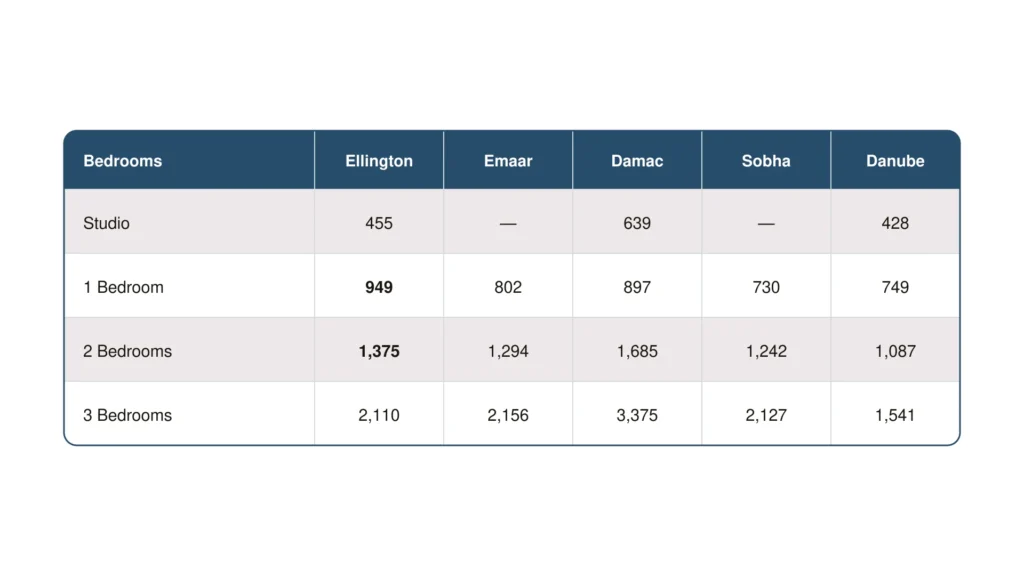
The one-bedroom line is the one worth studying. At 949 sqft it is the largest of the five and roughly 19% above the peer average. The one-bedroom is the workhorse of Dubai’s apartment stock, dominating both delivered and pipeline mix across these developers, so size here is something a resale buyer can physically measure. A 949 sqft one-bed and a 730 sqft one-bed are not the same product competing on price. They are different products.
Achieved price per square foot, Q2 2026 (AED)
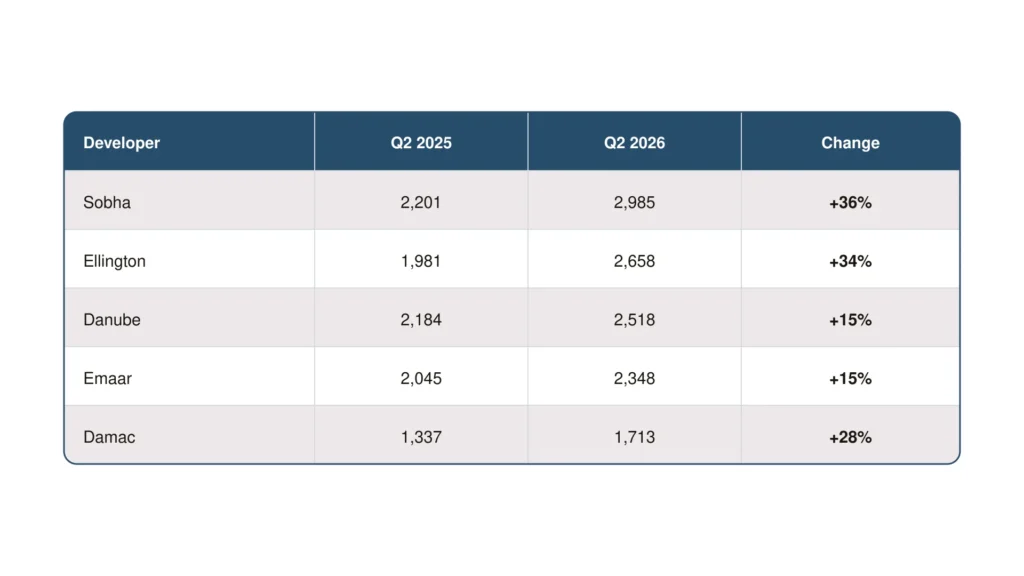
These are achieved transaction prices rather than list prices, which is the only version worth comparing. The spread across the table is about 74%. Five developers all selling Dubai apartments, and the top of the range achieves three-quarters more per square foot than the bottom. Specification, unit size and brand recognition are doing that work, and the gap does not close at resale. It usually widens, because the better-built building keeps looking better as both age.
The pattern that separates real demand from discounting
Between Q2 2025 and Q2 2026, Ellington’s transaction volume rose about 4.1 times while its achieved price per square foot rose 34%. Its share of primary sales value among the five benchmark developers went from 2.1% to 25.2%.
Volume and price normally move against each other. You sell more units by cutting the number. When both rise together it usually points to genuine demand rather than demand manufactured through incentives.
There is a caveat, though, and it changes how you should read that 25.2%. The peer group shrank. Combined Q2 primary sales value across the five developers fell from AED 48.4 billion to AED 16.3 billion year on year, a 66% contraction. Ellington was the only one of the five that grew in absolute terms. So the share figure reflects both real outperformance and a market where most large developers paused their launch programmes. I would treat the absolute growth as solid and the market-share number as directional.
The two risks that never appear in the brochure
The 2027 to 2028 handover wave
This is the one I would want any off-plan buyer to understand properly. Industry projections put more than 300,000 residential units across Dubai between 2025 and 2028, with handovers slowing through 2025 and 2026 and then surging in 2027.
Those forecasts have consistently overstated what actually completes. Of roughly 37,171 units forecast for 2025, analysis suggests around 22,896 actually completed, about 62%. For 2026, out of 71,613 forecast, roughly 34,740 are expected to reach handover, under half. Some analysts expect the resulting 2026 to 2027 peak to create short-term oversupply in the mass-market apartment segment, with price adjustments in the region of 10% to 15% and rental compression in the most saturated communities.
Individual developers face their own version of this. Ellington has 1,420 units due in 2026, then 3,375 in 2027 and 3,620 in 2028, against a historical peak of about 660 units in a single year and an average of 566 a year across 2022 to 2025. That is roughly a five-fold step-up on its best year and closer to six times its average. Its delivered book grows from 3,160 units in 2025 to around 16,905 by 2030.
The useful question is not whether a developer will deliver. It is whether they have scaled contractors, snagging teams and handover operations ahead of the curve, or whether they plan to scale when the units arrive. A visible delay damages a premium brand far more than a slow sales quarter, and it hits your resale price directly, because your building’s handover reputation becomes its resale reputation.
Pipeline concentration
Ellington’s under-construction pipeline spans 18 communities, but five of them carry 63% of it. Jumeirah Islands, Dubai Islands, Falcon City, JLT and Horizon account for 6,908 of 10,974 units. Dubai Islands on its own is ten projects.
This is not unique to one developer, it is simply how Dubai works at the moment. But it means that if you buy in a district where your developer has ten projects running simultaneously, your competition at resale is your own developer, still selling new stock in the same postcode at a launch price. In my experience that is the single most common reason a genuinely good building resells badly.
The liquidity question, and an uncomfortable number
Here is the part most developer comparisons leave out.
Premium pricing and thin resale volume sit awkwardly together. Ellington’s secondary market recorded 306 resales in the first six months of 2026, down from 800 across the whole of 2025, which annualises to roughly 612. Of those, 98% were apartments.
You can read that two ways and both are partly true. The negative reading is that thin resale volume means fewer comparable transactions, slower exits and wider price negotiation. The positive reading is that owners simply are not selling. Reported occupancy across delivered projects sits at around 96%, and rental premiums are estimated at 15% to 20% over generic stock in the same neighbourhoods, which suggests holders are collecting yield rather than flipping.
The practical version is this. If you buy a design-led premium product, plan a three to five year hold rather than a twelve-month flip. The data supports appreciation. It does not support instant liquidity.
Seven questions to ask before you sign anything
- How many units is this developer selling in this exact community right now? If the answer is several projects, you will be competing against them at resale.
- What is the achieved price per square foot here, rather than the list price? Achieved prices are the only honest benchmark.
- How does the usable size compare with the same bedroom count from competitors? A 19% size advantage is real and verifiable.
- What is the developer’s historical delivery run-rate against their forward schedule? A five or six-fold step-up is an operational risk, not a footnote.
- How many resale transactions has this developer’s stock done in the last twelve months? Thin volume means slow exits.
- What does the payment plan actually cost you in cash flow terms? Emaar collects 67% during construction, Ellington sits at roughly 19/50/31, Sobha has pushed 40% to completion and Danube offers around 5% post-handover. Those are very different propositions.
- Who is the second buyer? If you cannot describe them in a sentence, you have a hope rather than an exit strategy.
Where this leaves you
Dubai in 2026 is not a market where everything goes up. Roughly a third of activity happens in the secondary segment, and that segment becomes more selective every quarter. If your exit depends on selling into it, the developer you choose matters more than the unit you choose.
Location gets you liquidity. Build quality gets you the premium. Brand recognition gets you speed. Very few developers give you all three, and two out of three still puts you in a far better position than a discount from a developer who gives you none.
Choose the developer first. Everything else follows from there.

Let’s look at your situation specifically
Every number above changes meaning depending on what you are actually trying to do. A three to five year appreciation play, a rental-yield hold and a family home you will live in for a decade point to different buildings, and sometimes different developers entirely.
I go through this analysis with clients before they commit to anything: achieved-price data for the community you are looking at, the developer’s real delivery record, recent resale comparables, and an honest view of what your exit looks like.
Message me on WhatsApp or call +0971 50 297 1523
Tell me your budget and your timeline and I will tell you where the data points.
No obligation and no pitch deck.
If you want first access to pre-launch projects
The best pricing in Dubai is never on a public listing site. The strongest projects, the ones with the community, specification and unit sizes that survive resale, are largely allocated before the public launch at prices that never appear on any portal.
I keep a private list for clients who want first access to those allocations: pre-launch pricing, floor-plate selection ahead of general release, and a short written view on whether the project is actually worth it, including the ones I tell people to skip.
Request access at https://dubai-invest.veersant.com/.