

Figures reflect verified 2025–2026 data, compiled July 2026. All amounts are in UAE dirhams (AED). Costs vary by community, property type, school, transport choice and lifestyle.
Ask ten people what it costs to live in Dubai and you will get ten different answers, most of them wrong in the same predictable ways. The viral “live in Dubai for AED 8,050 a month” graphics are a good example. They read well, but they quietly mix a budget lifestyle with a comfortable one, leave out mandatory health insurance, ignore school fees entirely, forget the deposits and agency fees you pay before you move in, and in several cases count the same expense twice.
One recurring error is worth calling out early: home internet is often listed under “utilities” and again under “mobile and internet,” so the total looks lower than reality. Another is showing rent as a tidy monthly number without mentioning that Dubai leases are signed and paid annually, usually in one to four cheques. The result is a figure that feels precise but does not survive contact with a real tenancy contract.
This guide fixes that. It gives you the genuine monthly cost of living in Dubai for a single person and for a family of four, separates one-time costs from recurring ones, keeps public transport and car ownership in different scenarios, and shows how your choice of community and property changes the whole equation. The aim is to help you plan, not to sell you a postcode.
The Quick Answer: Monthly Cost of Living in Dubai
If you only read one part, read this. These are realistic moderate-lifestyle monthly estimates for 2026, in AED.
| At a glance, moderate lifestyle, 2026 (AED / month) Single person, public transport: ~9,800 Single person, with a car: ~11,050 Family of four, excluding school fees: ~20,100 Family of four, with affordable private schools: ~23,400 Family of four, with mid-range private schools: ~27,900 |
Budget lifestyles run lower and comfortable lifestyles higher, the full tables below show all three tiers. Housing and, for families, schooling are the two levers that move these numbers the most.
What This Guide Covers
- 1. Is Dubai expensive to live in?
- 2. Cost of living in Dubai for a single person
- 3. Public transport versus owning a car in Dubai
- 4. Cost of living in Dubai for a family of four
- 5. How school fees change a family’s budget
- 6. Dubai rent prices and housing costs by community
- 7. Upfront costs of renting and moving to Dubai
- 8. How your property choice affects the cost of living
- 9. Renting versus buying property in Dubai
- 10. Practical ways to reduce living expenses in Dubai
- 11. Commonly overlooked Dubai expenses
- 12. Frequently asked questions
- 13. Conclusion and how Behniya can help
1. Is Dubai Expensive to Live In?
There is no single answer, because Dubai cost of living behaves like a set of dials rather than one fixed price. Two people on identical salaries can spend wildly different amounts depending on the choices they make.
The biggest dial is housing location and property size, a studio in Discovery Gardens and a two-bedroom in Al Barsha are different worlds. Family structure matters next: a single professional and a family of four do not shop, commute or insure the same way. School choice can add more to a family budget than rent. Transport is a genuine fork in the road, a monthly Metro pass costs a fraction of running a car. And lifestyle, dining and entertainment quietly separate a “surviving” budget from a comfortable one.
One more factor is often decisive: employer-provided benefits. Many Dubai packages include housing allowances, health insurance, and sometimes school-fee support. If yours does, your out-of-pocket cost of living in Dubai can be far lower than the headline numbers here. Read every figure below as the full cost before any employer contribution.
2. Cost of Living in Dubai for a Single Person
The table below sets out realistic monthly living expenses in Dubai for a single adult renting a studio or small one-bedroom in a well-connected mid-market community, cooking mostly at home and dining out occasionally. Internet is counted once. The 5% housing fee (billed monthly through your DEWA account) is shown on its own line. Public transport and car ownership are kept in separate scenarios and never added together.
| Expense category | Budget | Moderate | Comfortable | Important notes |
| Rent (studio / small 1BR) | 3,500 | 5,000 | 7,000 | Annual lease; mid-market community. Prime districts cost far more. |
| Housing fee (5% of rent ÷12) | 145 | 210 | 290 | Billed monthly via DEWA; easy to overlook. |
| DEWA (electricity + water) | 300 | 400 | 550 | Rises sharply in summer with AC use. |
| District cooling (if applicable) | 150 | 250 | 300 | Separate chiller bill in many buildings; chiller-free units fold it into rent. |
| Home internet | 300 | 389 | 450 | Counted once. Fibre ~389–460; basic 5G home from ~236. |
| Mobile plan | 125 | 200 | 300 | Postpaid with data. |
| Groceries | 700 | 850 | 1,100 | Mostly home cooking. |
| Dining out (occasional) | 300 | 600 | 1,000 | Cafes and casual restaurants. |
| Public transport (Nol pass) | 230 | 350 | 350 | 2-zone pass 230; all-zone 350. See car scenario separately. |
| Health insurance | 100 | 250 | 400 | Legally mandatory. Basic plan ~1,200/yr; comprehensive higher. |
| Entertainment & outings | 300 | 600 | 1,000 | Cinema, weekend activities. |
| Clothing, personal care & misc. | 450 | 700 | 1,200 | Grooming, shopping, incidentals. |
| MONTHLY TOTAL (public transport) | 6,600 | 9,800 | 13,940 | Utilities line combines DEWA + cooling shown above. |
Surviving versus living well. The AED 8,050 figure that circulates online sits between the Budget (6,600) and Moderate (9,800) columns. In other words, it is a frugal single-person floor, achievable if you take an affordable studio, cook at home and rely on the Metro, but it is not the relaxed, occasionally-eat-out, properly-insured lifestyle most newcomers imagine. A genuine moderate lifestyle for one person is closer to AED 9,800 a month on public transport.
3. Public Transport Versus Owning a Car in Dubai
Transport is where a single budget can swing by more than a thousand dirhams. The comparison below shows why. Crucially, a car’s purchase price is not a monthly cost, instead, ownership is expressed as a realistic monthly running estimate that includes depreciation, fuel, insurance, registration, Salik and maintenance.
| Metro & bus | Monthly Nol pass 230–350 | — |
| Taxi / ride-hailing | Occasional ~100–300 | Rare |
| Car finance / depreciation | — | Spread into the monthly ownership estimate |
| Fuel | — | ~400–700 (petrol ~AED 3.29/L, Jul 2026) |
| Insurance | — | ~150–400 (1,200–5,000/yr) |
| Registration | — | ~45 (~520/yr) |
| Salik (tolls) | — | ~160–200 |
| Parking | — | Variable by area/building |
| Maintenance | — | ~150–300 |
| Typical monthly total | ~230–350 (+ occasional taxi) | ~1,300–2,000 all-in |
If your home, office and daily errands sit near a Metro line, public transport is dramatically cheaper. A car earns its keep when you live in a car-dependent community, commute across the city, or have a family to move around, which is why the family budget below assumes one car.
4. Cost of Living in Dubai for a Family of Four
This budget assumes two adults and two children (roughly 6 and 10), a two-bedroom apartment in a mid-market community, mostly home cooking with occasional dining out, and one family car. Health insurance covers all four. School fees are handled separately in the next section, because they swing the total more than any other line and not every family pays the same tier.
| Expense category | Budget | Moderate | Comfortable | Important notes |
| Rent (two-bedroom apartment) | 7,000 | 9,000 | 12,000 | Annual lease; mid-market community. |
| Housing fee (5% of rent ÷12) | 290 | 375 | 500 | Billed monthly via DEWA. |
| DEWA (electricity + water) | 550 | 750 | 950 | Larger home, higher summer AC load. |
| District cooling (if applicable) | 350 | 450 | 550 | Separate chiller bill where it applies. |
| Home internet | 350 | 389 | 450 | Counted once. |
| Mobile plans (×2 adults) | 300 | 450 | 600 | Two postpaid lines. |
| Groceries & household essentials | 2,000 | 2,800 | 3,500 | Food plus cleaning, toiletries, nappies etc. |
| Dining out (occasional) | 500 | 900 | 1,500 | Family meals out. |
| Transport / one family car | 1,400 | 1,700 | 2,200 | All-in car running cost; no public-transport line added. |
| Health insurance (×4 people) | 500 | 1,000 | 1,800 | Mandatory for all residents. |
| Entertainment & family activities | 500 | 900 | 1,500 | Outings, clubs, weekends. |
| Clothing, personal care & misc. | 900 | 1,400 | 2,200 | Four people; children grow fast. |
| SUBTOTAL (excluding school fees) | 14,640 | 20,114 | 27,750 | Add schooling from the next section. |
Even before a single school fee, a moderate family of four spends around AED 20,000 a month. The DEWA and district-cooling lines above are shown separately so you can see how a chiller-free building would remove the cooling row and lower the total.
5. How School Fees Change a Family’s Budget
Private schooling is usually unavoidable for expatriate families, government schools are generally reserved for Emirati children. Tuition is only part of the cost: transport, books, uniforms, activities and compulsory charges add roughly 15–25% on top. The “all-in” monthly figures below bundle those extras with tuition for two children in primary grades.
| Family total (AED / month) | Excl. school | + Affordable schools | + Mid-range schools |
| Two children — tuition only | — | 2,333 | 6,667 |
| + school transport | — | 583 | 667 |
| + books, uniforms, activities | — | 333 | 500 |
| School package, all-in | — | 3,250 | 7,800 |
Applied to the moderate family budget, the picture looks like this:
| Scenario | Budget family | Moderate family | Comfortable family |
| Excluding school fees | 14,640 | 20,114 | 27,750 |
| With two children in affordable schools | 17,890 | 23,364 | 31,000 |
| With two children in mid-range schools | 22,440 | 27,914 | 35,550 |
Why tuition alone is misleading: a school advertising, say, AED 40,000 per child can easily cost AED 47,000 once transport, uniforms, books and activity fees are added. For two children, mid-range schooling can rival or exceed the rent, which is exactly why families should weigh a home’s distance from good schools as carefully as its rent.
6. Dubai Rent Prices and Housing Costs by Community
Housing is almost always the largest monthly expense, so it deserves the closest look. Dubai rent prices are advertised and contracted annually; the monthly equivalent is simply the annual figure divided by twelve. The table shows current 2025–2026 asking ranges for popular mid-market Dubai communities, after the sharp rent rises of 2023–2025.
| Community | Studio / 1-bed (AED/yr → /mo) | Two-bed (AED/yr → /mo) | Suitable for & transport notes |
| JVC | Studio 40–55k → 3.3–4.6k; 1BR 60–90k → 5.0–7.5k | 90–145k → 7.5–12.1k | Singles, couples, small families; car-friendly, limited Metro. |
| Arjan | Studio 42–55k → 3.5–4.6k; 1BR 60–80k → 5.0–6.7k | 85–110k → 7.1–9.2k | Value-seekers; car recommended. |
| Discovery Gardens | Studio 38–52k → 3.2–4.3k; 1BR 55–75k → 4.6–6.3k | 78–95k → 6.5–7.9k | Budget-conscious; Metro-connected. |
| Dubai Silicon Oasis | Studio 42–55k → 3.5–4.6k; 1BR 60–78k → 5.0–6.5k | 85–110k → 7.1–9.2k | Families, tech workers; car-friendly. |
| Dubai Sports City | Studio 38–52k → 3.2–4.3k; 1BR 55–72k → 4.6–6.0k | 80–100k → 6.7–8.3k | Active singles/families; car needed. |
| Town Square Dubai | Studio 38–50k → 3.2–4.2k; 1BR 60–78k → 5.0–6.5k | 78–110k → 6.5–9.2k | Young families, parks; car-dependent. |
| Al Barsha | Studio 45–65k → 3.8–5.4k; 1BR 60–85k → 5.0–7.1k | 85–120k → 7.1–10.0k | Central, near schools/Metro; higher rent. |
Advertised rents are not fixed. The same apartment can be priced differently depending on the number of cheques (fewer cheques usually means a lower rent, while 6–12 cheques can push it up 5–10%), the building’s age and condition, whether it is furnished, its proximity to public transport, on-site amenities, whether cooling is district-supplied or chiller-free, and simple supply and demand in that community at that moment.
7. Upfront Costs of Renting and Moving to Dubai
These are one-time or first-year costs and must never be blended into a monthly budget. Refundable deposits are returned when you move out, they are a cash-flow requirement, not an expense. The distinction is marked in the final column.
| Item | Typical cost | Refundable? |
| Security deposit | 5% of annual rent (unfurnished), 10% furnished | Refundable |
| Agency commission | 5% of annual rent + 5% VAT | No |
| Ejari registration | ~AED 220 online / ~350 typing centre | No |
| DEWA deposit + activation | AED 2,000 (apartment) + ~130 activation | Deposit refundable |
| District-cooling deposit | ~AED 1,000–2,000 (Empower/Emicool) | Refundable |
| Internet installation | Often free on contract; router deposit may apply | Mostly no |
| Furniture & moving | AED 5,000–30,000 depending on the home | No |
| Visa / residency (family sponsor) | ~AED 5,000–7,000 per dependent | No |
| Car registration (if buying a car) | ~AED 520 per year | No |
| School registration & admission | ~5% of annual tuition + deposit | Partly |
Worked example (single person, studio at AED 60,000/yr): security deposit 3,000 (refundable) + agency 3,150 + Ejari ~350 + DEWA deposit 2,000 (refundable) ≈ AED 8,500 before furniture, of which about 5,000 comes back to you at move-out. Employment visas are usually employer-paid; family sponsorship is not.
8. How Your Property Choice Affects the Cost of Living
This is where the cost of living in Dubai stops being a spreadsheet and becomes a decision. The property and community you choose can quietly add or remove thousands of dirhams a month, often in ways the advertised rent never reveals.
A cheaper home far from your work or your children’s school can cost more overall once you add fuel, Salik, extra car wear and lost time. A slightly pricier apartment near a Metro station can let a single person skip car ownership entirely — a saving of AED 1,000-plus a month. Chiller-free buildings roll cooling into the rent, which smooths summer bills; district-cooled towers separate it out, with a fixed capacity charge you pay even when you are away.
Newer buildings often bring better insulation, working lifts and lower maintenance friction, while some older buildings offer more space for the money. For families, proximity to good schools, supermarkets and clinics reduces both spending and daily stress. And if you plan to stay several years, it is worth modelling annual rent against the cost of buying property in Dubai, because a long horizon changes the maths. None of these choices has a universally “right” answer; the point is to price the whole package, not just the rent line.
9. Renting Versus Buying Property in Dubai
Buying is not automatically better than renting. The right call depends on how long you expect to stay, the deposit you can raise, your mortgage eligibility, transaction costs, the community you want, ongoing service charges, and your personal and financial goals. A short stay usually favours renting; a longer horizon with a solid deposit is where buying property in Dubai starts to compete on cost.
| Factor | Renting | Buying |
| Flexibility | High — move at lease end | Lower — selling takes time and cost |
| Upfront capital | Deposit + fees (~1 month equiv.) | ~20%+ down payment plus transfer fees |
| Monthly predictability | Fixed for the lease; can rise on renewal | Mortgage stable, but service charges vary |
| Long-term ownership | No equity built | Builds equity; exposure to the Dubai property market |
| Additional expenses | Annual rent increases, agency fees | Service charges, maintenance, transaction costs |
For some residents, Dubai real estate investment is a genuine long-term goal; for others, renting keeps life flexible while they settle in. Both are valid. The sensible move is to compare a specific property’s total ownership cost against the rent you would otherwise pay in the same community, rather than deciding in the abstract.
10. Practical Ways to Reduce Living Expenses in Dubai
Advice that actually applies to Dubai, not generic saving tips:
- Choose your community around where you work and where your children study, commute cost is a hidden rent.
- Compare chiller-free and district-cooled buildings before signing; cooling can be a large, separate summer bill.
- Time big grocery runs with the annual promotions at major retailers, and split bulk buys.
- Review your telecom package yearly, home internet and mobile plans often have cheaper equivalents.
- Favour a Metro-accessible home if you are single; it can remove the need for a car altogether.
- Negotiate the number of rent cheques, fewer cheques often lowers the annual rent.
- Compare schools on the all-in cost (transport, books, uniforms, activities), not tuition alone.
- Track Salik, parking and fuel monthly if you drive; small daily costs add up fast.
- Do not chase a cheaper property that creates an expensive, time-consuming commute.
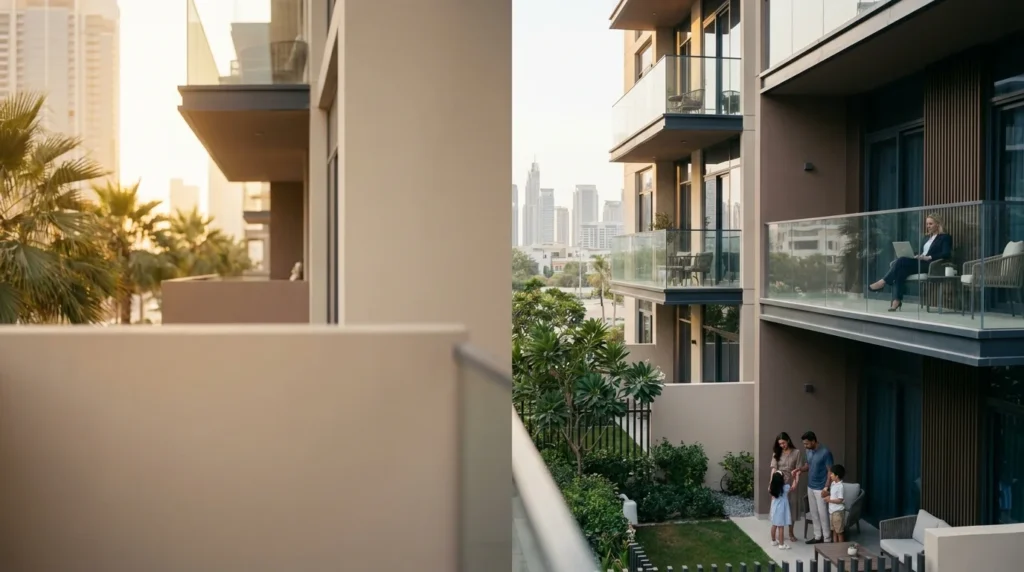
11. Commonly Overlooked Dubai Expenses
The costs that catch newcomers by surprise are rarely the obvious ones. Watch for: Ejari registration and security deposits at move-in; district cooling and its fixed capacity charge; Salik tolls and paid parking if you drive; school uniforms and books on top of tuition; visa and Emirates ID costs for family members; mandatory medical insurance; furniture for an unfurnished unit; routine maintenance; agency fees; annual rent increases at renewal; and holiday or home-country travel, which many residents budget for but forget to count.
FAQ
How much money does a single person need to live in Dubai?
A frugal single person can manage on around AED 6,600 a month, but a realistic moderate lifestyle, with proper health insurance and occasional dining out, is closer to AED 9,800 on public transport, or about AED 11,050 with a car. A comfortable lifestyle runs to roughly AED 13,900–15,600.
How much does a family of four need per month in Dubai?
Excluding school fees, a moderate family of four spends about AED 20,100 a month. With two children in affordable private schools that rises to roughly AED 23,400, and with mid-range schools to about AED 27,900. Budget families can live for less; comfortable families spend more.
Is AED 8,000 enough for one person in Dubai?
It can be, but only for a lean lifestyle: an affordable studio, home cooking and public transport. AED 8,000 sits between our budget and moderate single-person figures, and popular online estimates that land near it often omit health insurance and the housing fee, so treat it as a floor rather than a comfortable middle.
Is AED 15,000 enough for a family of four in Dubai?
It is tight. A budget family excluding school fees is around AED 14,640, so AED 15,000 leaves almost nothing for private schooling. Families paying school fees should plan for roughly AED 18,000–28,000 a month depending on the school tier.
What is the biggest living expense in Dubai?
Housing, in almost every case, it is typically the single largest monthly cost. For families paying private-school fees, schooling can rival or even exceed rent, which is why the two should be planned together.
Is it cheaper to use the Metro or own a car in Dubai?
The Metro is far cheaper for a single person near a station, a monthly Nol pass is AED 230–350, versus roughly AED 1,300–2,000 a month to run a car once fuel, insurance, registration, Salik and maintenance are included. A car makes sense for families or car-dependent communities.
Which Dubai communities offer more affordable rent?
Among popular mid-market areas, Discovery Gardens, Town Square, Dubai Sports City and Arjan tend to sit at the lower end, while Al Barsha and parts of JVC run higher for their central location and amenities. Always weigh rent against commute and Metro access.
Is it better to rent or buy property in Dubai?
It depends on your time horizon, deposit, mortgage eligibility and goals. Short stays usually favour renting for its flexibility; longer stays with a solid deposit are where buying property in Dubai becomes competitive. Compare a specific property’s total ownership cost against the equivalent rent before deciding.
13. Conclusion and How Behnia Can Help
The real cost of living in Dubai is not a single number, it is a range shaped by where you live, how you commute, how many people you support and which school you choose. A single professional can live well on around AED 9,800 a month; a family of four with children in mid-range schools should plan for close to AED 27,900. Housing and, for families, schooling are the two decisions that move everything else.
That is also the good news: because so much of your monthly cost of living in Dubai is tied to your home and community, the right property choice is one of the few levers that genuinely lowers your total spend. A well-located, well-configured home can save on transport, cooling and time all at once.
This is exactly where Behniya helps, comparing properties and communities against your real lifestyle and budget, so you can see the full cost of a home, not just its advertised rent.
Plan your move around the full picture
Your housing choice can reshape your entire monthly cost of living in Dubai. Before you commit to a property on rent alone, compare the complete cost of the community, commute, utilities and lifestyle, and talk it through with someone who knows the market.
Sources and Data Notes
Figures reflect verified 2025–2026 data, compiled July 2026. Prices are ranges because they vary by community, building, season and lifestyle. Primary and market sources:
- Rent — Bayut Dubai Rental Market Report H1 2025 and community indices (JVC, DSO, Arjan, Discovery Gardens, Town Square): bayut.com/mybayut/bayut-h1-2025-dubai-rental-market-report/
- Rent — Property Finder Al Barsha listings & 2026 rent-payment guide: propertyfinder.ae/blog/paying-rent-dubai/
- Utilities — DEWA bill structure & 5% housing fee: egsh.ae/insights/dewa-bill-explained
- District cooling — Empower official charges: empower.ae/customer-care/charges-explanation/
- Internet & mobile — du (du.ae) and e& / etisalat (etisalat.ae) official plans; UAE 2026 comparison: tbreak.com
- Transport — Silver Nol monthly pass & fares 2026: stations.ae/silver-nol-card-monthly-pass/ and dubaimetrorails.com
- Petrol — UAE fuel prices July 2026: gulfnews.com (Special 95 = AED 3.29/L)
- Car ownership — UAE 2026 breakdown: automarket.ae/guides/car-ownership-cost-uae
- Health insurance — Pacific Prime Dubai 2026 (individual & family): pacificprime.com
- School fees — KHDA-referenced Khaleej Times 2026-27 tuition guide; iSchoolAdvisor 2026 breakdown
- Groceries — StartDXB 2026 weekly-shop guide: startdxb.ae